
Executive Overview
The smartphone industry has long operated under a strict design consensus: slabs of illuminated glass powered by OLED or LCD panels dominate the market, optimized for high-refresh-rate media consumption, vibrant color reproduction, and rapid response times. However, this mainstream ubiquity has created persistent trade-offs. The constant emission of high-energy visible (HEV) blue light, screen glare under direct sunlight, and the relentless pull of infinite-scroll applications have given rise to widespread consumer fatigue.
Enter the niche yet fiercely dedicated world of E Ink mobile devices. For years, manufacturers have attempted to marry the eye-friendly, paper-like reading experience of electrophoretic displays with the daily utility of a pocket-sized smartphone. Yet, these hybrid devices have traditionally forced users to compromise: E Ink screens are phenomenal for reading eBooks, documents, and long-form articles, but they struggle profoundly with high-velocity video playback, rapid user-interface animations, and rich media consumption, even with advanced ghost-reduction algorithms.
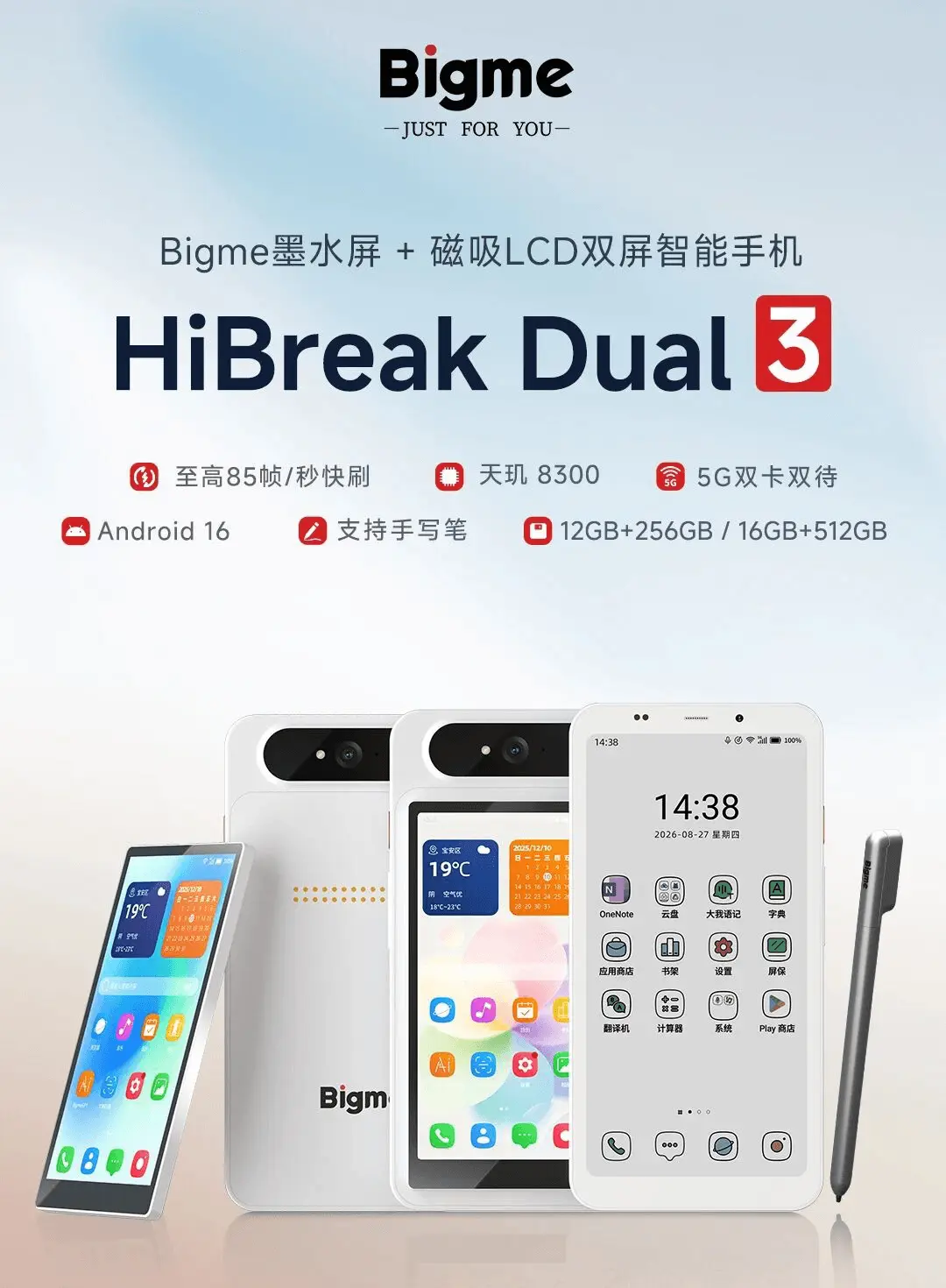
Unveiled in late August 2026, the Bigme HiBreak Dual 3 represents a radical departure from these historical compromises. Rather than forcing a single, static screen technology onto the user, or adopting the bulky dual-screen book-fold designs popularized by foldable OLED phones, Bigme has engineered a truly novel hybrid approach. The HiBreak Dual 3 pairs a primary, high-performance color E Ink display on the front with a removable, magnetic color LCD module on the back.
Read Also
This modular architecture fundamentally redefines how a user interacts with a secondary screen. By transforming the traditional auxiliary display from a permanent, power-draining fixed panel into a snap-on accessory, Bigme has created a device that pivots seamlessly between an eye-friendly, distraction-free monochrome and color e-reader tool, and a fully dynamic multimedia smartphone. Powered by flagship-tier silicon, running the latest Android operating system, and boasting robust memory configurations, the HiBreak Dual 3 is not merely an iterative update; it is an aggressive, forward-thinking blueprint for the future of specialized mobile computing.
Detailed Chronology: Evolution of the HiBreak Lineage
To understand the engineering marvel and strategic positioning of the Bigme HiBreak Dual 3, one must trace the developmental trajectory of Bigme’s mobile hardware strategy. The journey from standard E Ink tablets to pocket-sized, telephony-enabled e-paper devices has been fraught with technical hurdles, primarily centered around screen refresh rates, ghosting mitigation, and hardware performance ceilings.
The Genesis of E Ink Telephony
Early attempts at E Ink smartphones—pioneered by brands like YotaPhone with its dual-screen back-to-back LCD and E Ink panels, and later advanced by Hisense with dedicated e-reader phones—proved that a distinct consumer base desired phone-sized reading devices. Consumers loved the battery endurance and outdoor legibility, but they routinely criticized the sluggish processors, low RAM, and agonizingly slow screen response times that made basic tasks like GPS navigation or web browsing frustrating.
When Bigme entered the fray with the original HiBreak series, the company aimed to shatter the stereotype that E Ink phones had to be underpowered secondary devices. Early HiBreak models introduced color E Ink technology to a phone-form-factor chassis, attempting to bridge the gap between static text and colorful user interfaces. However, early color E Ink (such as Kaleido-based panels) suffered from muted color saturation and dark front-light layers that muted overall brightness.
Refining the Refresh Rate and Performance
With the second-generation iterations, Bigme began addressing the core bottleneck of e-paper technology: the refresh rate. E Ink panels naturally work by physically moving charged pigment capsules, a process that inherently causes lag and visual ghosting when scrolling rapidly through text or feeds. Bigme invested heavily in proprietary refresh algorithms, pushing refresh rates upward to create smoother scrolling experiences.
Concurrently, the company recognized that users wanted to use their E Ink phones as primary daily drivers rather than secondary novelty gadgets. This realization mandated a shift away from low-end, power-sipping microcontrollers toward genuine, mid-to-high-tier mobile processors capable of handling modern multitasking demands, heavy background applications, and encrypted security protocols.
The Modular Breakthrough of 2026
The culmination of this iterative engineering led directly to the August 2026 announcement of the Bigme HiBreak Dual 3. Instead of stacking a secondary low-power E Ink screen on the back of a primary LCD (as seen in legacy dual-screen phones), or trying to force a single E Ink screen to handle intensive 60-frames-per-second video streaming, Bigme completely inverted the paradigm.
The front-facing primary display became an advanced, high-refresh-rate color E Ink panel optimized for reading, productivity, and stylus-based annotation. Meanwhile, the back of the device was engineered to accept a physical, magnetic, detachable color LCD module. This evolution solved a multi-year industry dilemma: how to give users access to vibrant, high-framerate multimedia without forcing them to carry a heavy, power-hungry dual-screen device or compromise on eye health during the 90% of the day spent reading, messaging, and working.
Supporting Context & Metrics: Specifications and Hardware Architecture
The technical specifications of the Bigme HiBreak Dual 3 place it in a league entirely its own. Historically, E Ink devices have been paired with entry-level chipsets to preserve battery life, resulting in sluggish performance that alienated mainstream tech enthusiasts. Bigme has deliberately shattered this convention.
+--------------------------------------------------------------------------+
                   BIGME HIBREAK DUAL 3: CORE METRICS
+--------------------+-----------------------------------------------------+
| Component          | Specification                                       |
+--------------------+-----------------------------------------------------+
| Front Display      | Advanced Color E Ink (85 Hz Refresh Rate)           |
| Stylus Support     | 4096-Level Pressure Sensitivity                     |
| Rear Module        | Detachable Magnetic Color LCD                       |
| Processor          | MediaTek Dimensity 8300                             |
| Memory (RAM)       | 12GB or 16GB                                        |
| Storage            | 256GB or 512GB                                      |
| Connectivity       | Global 5G Dual-SIM                                  |
| Operating System   | Google Android 16 (Full Google Play Store Access)   |
+--------------------+-----------------------------------------------------+
The Front Display: High-Refresh Color E-Paper
At the heart of the user experience is the primary front-facing display. Utilizing state-of-the-art color E Ink technology, the panel achieves an unprecedented 85 Hz refresh rate. In the realm of electronic paper, where refresh rates traditionally hovered between 10 Hz and 15 Hz (requiring aggressive, jarring full-screen flashes to clear ghosting), an 85 Hz refresh rate is revolutionary. It virtually eliminates the jarring lag and visual ghosting that has plagued e-readers for over two decades, enabling smooth, fluid scrolling through web pages, emails, and social media feeds.
Furthermore, this front display integrates active 4096-level pressure-sensitive stylus support. This transforms the HiBreak Dual 3 from a passive consumption device into an active productivity powerhouse. Users can annotate PDF documents, sketch complex diagrams, and take handwritten meeting notes with sub-millimeter precision, leveraging the tactile friction of the e-paper surface which closely mimics physical paper.
The Detachable Rear LCD Module
The defining engineering triumph of the device is its modular rear architecture. When attached via a secure array of high-strength magnets and gold-plated data/power pins, the removable color LCD module instantly converts the device into a traditional multimedia powerhouse.
- When Attached: Users gain access to a vibrant, high-definition LCD screen capable of fluid video playback at standard cinematic frame rates, rich color accuracy for gaming, and vibrant photo editing capabilities.
- When Detached: The phone sheds unnecessary weight and power consumption, revealing a sleek, minimalist rear chassis featuring a streamlined, pill-shaped camera module housing a single high-resolution lens and an LED flash. This modular swap allows the device to adapt dynamically to the user’s immediate environment—whether they are stepping into bright sunlight where E Ink shines, or settling in for an evening of media streaming where LCD reigns supreme.
Processing Power and Memory Configurations
Underneath its dual-screen exterior, the HiBreak Dual 3 is powered by the MediaTek Dimensity 8300 processor. Built on an advanced manufacturing node, the Dimensity 8300 delivers blistering multi-core performance, exceptional energy efficiency, and native support for modern AI workloads and 5G connectivity. For an E Ink device, deploying a processor of this caliber is unprecedented; it ensures that the user interface remains snappy, application launch times are instantaneous, and heavy enterprise software runs without a stutter.

To complement this silicon, Bigme offers two robust memory and storage tiers designed for power users:
- The Standard Professional Tier: 12GB of high-speed LPDDR5 RAM paired with 256GB of internal UFS storage.
- The Flagship Power Tier: 16GB of LPDDR5 RAM paired with a massive 512GB of internal UFS storage.
These configurations ensure that users can store extensive local libraries of academic texts, high-resolution audiobooks, offline maps, and heavy multimedia files without ever worrying about storage constraints.
Connectivity, Software, and Physical Ergonomics
Global connectivity is guaranteed via full 5G Dual-SIM capabilities, ensuring high-speed data access across international bands without dropped connections.
On the software front, the device ships running Google Android 16 straight out of the box. Crucially, unlike many niche e-reader imports that lack core services, the HiBreak Dual 3 features full, native access to the Google Play Store. This means users are not restricted to a walled garden of curated e-reader apps; they can download and install any mainstream productivity suite, messaging platform, banking app, or navigation tool available in the Android ecosystem.
Physically, the device maintains a remarkably compact footprint despite its complex modular engineering. By keeping the base chassis slim and lightweight, Bigme ensures that whether the LCD module is snapped on or left behind in a bag, the phone remains comfortable to hold during extended one-handed reading sessions.
Official Statements & Industry Reception
The announcement of the Bigme HiBreak Dual 3 has sent ripples through both the mainstream mobile tech community and specialized digital reading forums. Industry analysts and early hardware reviewers have praised Bigme for stepping outside the rigid design paradigms enforced by dominant smartphone conglomerates.
In early press briefings surrounding the late-August 2026 unveiling, Bigme’s product development leadership emphasized that the core philosophy of the HiBreak series has always been centered on digital wellness and cognitive preservation.
"We live in an era of sensory overload," noted a lead hardware engineer during Bigme’s product showcase. "Consumers are increasingly aware of the physical and psychological toll exacted by constant exposure to high-intensity blue light, erratic notification loops, and glaring glass screens. With the HiBreak Dual 3, we refused to ask our users to choose between their eye health and their modern digital lifestyle. By decoupling the multimedia screen into a removable magnetic module, we have built a device that respects your focus when you need to work or read, yet remains entirely flexible when you demand entertainment."
Initial reception from independent tech reviewers has been overwhelmingly positive, particularly regarding the inclusion of the MediaTek Dimensity 8300 processor. For years, reviewers of E Ink phones have been forced to append a caveat to their verdicts: "The screen is wonderful, but the processor is too slow for daily tasks." With the HiBreak Dual 3, that caveat has been decisively erased. Reviewers note that pairing an 85 Hz color E Ink panel with a modern upper-mid-range SoC creates a fluid, zero-compromise text-and-productivity experience that finally makes an E Ink phone viable as a primary, singular daily driver.
Furthermore, ergonomic specialists have lauded the magnetic modularity. Rather than forcing users to carry a bulky, double-thick phone with two permanent screens operating simultaneously—which invariably drains the battery twice as fast—the snap-on LCD module provides a targeted solution for a specific use case, preserving battery integrity and structural sleekness during standard operational hours.
Future Outlook: Implications for the Mobile Landscape
As the mobile industry watches developments closely, the Bigme HiBreak Dual 3 serves as a fascinating case study in alternative hardware design. While foldable displays have dominated headlines for luxury consumers, their high failure rates, exorbitant price points, and fragile plastic screens have limited their mainstream penetration. Modular e-paper technology, by contrast, targets a deeply underserved psychological and physiological need: the desire to disconnect from the visual toxicity of bright screens without sacrificing the utility of modern telecommunications.
Pricing and Availability Horizon
As of late August 2026, Bigme has not yet disclosed official retail pricing or a definitive global release date for the HiBreak Dual 3. Industry insiders speculate that given the high-end MediaTek Dimensity 8300 silicon, the dual-screen configuration, and the inclusion of advanced stylus tech, the device will be positioned as a premium product within the specialized e-reader market.
Prospective buyers and technology enthusiasts are advised to monitor official channels closely. As production yields stabilize and regulatory certifications clear across North American, European, and Asian markets, more details regarding launch windows and regional pricing are expected to emerge.
The Road Ahead for E-Paper Innovation
The arrival of the HiBreak Dual 3 signals a maturing market for electrophoretic technology. As refresh rates climb past 85 Hz, color saturation improves via advanced micro-cup architectures, and powerful mobile processors are integrated into specialized chassis, the traditional boundaries separating "e-readers" from "smartphones" are dissolving.
If the Bigme HiBreak Dual 3 achieves commercial traction, it could compel larger, mainstream manufacturers to rethink their monochromatic and low-power strategies. We may witness a broader industry shift toward modular accessory ecosystems, where consumers can customize their pocket hardware based on daily intent rather than being locked into a monolithic, glass-slab standard. Until then, Bigme stands alone at the vanguard of modular e-paper innovation, offering a tantalizing glimpse into a more balanced, ergonomic, and customizable digital future.




Comments
Facebook App ID not configured. Please add it in the Customizer.