
Executive Overview
The landscape of American higher education is undergoing a profound and structural transformation. For generations, the humanities—spanning literature, history, philosophy, and foreign languages—served as the intellectual bedrock of the undergraduate experience, cultivating critical thinking, ethical reasoning, and cultural literacy. Today, however, that foundation is visibly fracturing.
According to a sobering new report published by Humanities Indicators, a flagship project of the American Academy of Arts & Sciences, the percentage of undergraduate degrees conferred in the humanities in the United States has plummeted to 8.1% as of 2025. This figure represents a dramatic contraction from two decades ago, when nearly 15% of all bachelor’s degrees awarded nationwide were in humanities disciplines.
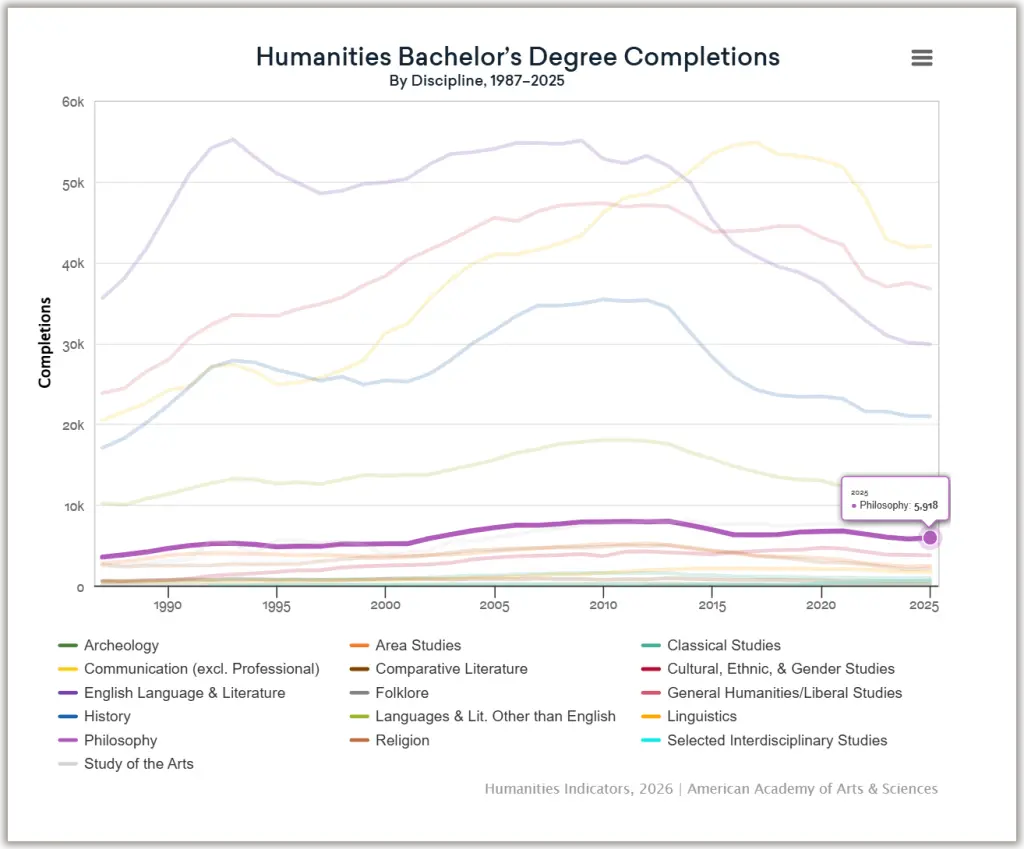
The numbers tell a story of sustained, systemic retrenchment. In 2025, the nation’s colleges and universities awarded just 164,847 bachelor’s degrees in the humanities. This is the lowest total recorded since 1991 and sits a staggering 30.4% below the recent high-water mark achieved in 2012.
Read Also
While the broader cultural conversation often points to the rising cost of college tuition, anxieties over post-graduate employability, and the hyper-specialization of the modern workforce as drivers of this shift, the granular data reveals a more complex crisis. Almost every traditional sub-discipline within the humanities has experienced severe, long-term erosion. Yet, amidst widespread contractions, isolated pockets of resilience—such as a modest uptick in philosophy majors and a rise in interdisciplinary programs—suggest that while traditional departments are shrinking, student interest in the fundamental questions of human existence is merely being re-channeled.
This report explores the trajectory of the decline, breaks down the performance of individual disciplines, examines the unique stabilization seen within philosophy, and evaluates the broader future outlook for the humanities in an increasingly STEM-centric academic ecosystem.
Detailed Chronology: Charting the Decadal Slide
To understand the current state of the humanities, one must trace the trajectory of enrollment and graduation rates over the past fifteen years. The decline has not been a sudden cliff, but rather a relentless downward slope punctuated by periods of accelerated loss.
The 2012 Peak and the Subsequent Slide
The year 2012 stands as the modern zenith for humanities degree conferrals in the United States, following a post-recession wave where students briefly sought refuge in higher education. At that time, humanities departments were processing record numbers of majors. However, as the broader economic recovery took hold and the tech sector experienced an unprecedented boom, the cultural and economic calculus surrounding college majors shifted dramatically.
Between 2012 and the onset of the COVID-19 pandemic, humanities programs suffered a steady, grinding attrition. Students increasingly migrated toward STEM (Science, Technology, Engineering, and Mathematics) fields, computer science, and career-oriented business programs, viewing them as safer bets against mounting student loan debt.
The Pandemic Acceleration (2021–2023)
The downward trend took a particularly sharp and alarming turn in the wake of the pandemic. Data from the Humanities Indicators report highlights an acute 12.7% drop in humanities degrees between 2021 and 2023.
Higher education analysts attribute this steep drop-off to several interrelated factors:
- The Remote Learning Disconnect: Humanities disciplines rely heavily on Socratic dialogue, small-group seminars, and vibrant classroom discussions. The transition to remote learning during the pandemic hollowed out the interactive seminar experience, alienating many students who might otherwise have declared humanities majors.
- Economic Anxiety: The economic instability of the pandemic years hyper-focused both students and parents on immediate return on investment (ROI). In times of uncertainty, pragmatic, job-skills-focused majors invariably cannibalize enrollment from liberal arts disciplines.
- Institutional Budget Cuts: Faced with structural budget deficits, universities across the country began pruning under-enrolled programs. Humanities departments, already bearing the brunt of cultural devaluing, were disproportionately targeted for faculty buyouts, department mergers, and program eliminations.
The Slowing Contraction (2023–2025)
While the bleeding has not stopped, recent year-over-year data indicates that the rate of decline is beginning to flatten.
Following the precipitous drop ending in 2023, the contraction slowed to a 2.1% drop from 2023 to 2024. This stabilization trend continued into the most recent academic year, with a further decline of just 0.4% from 2024 to 2025—marking the smallest year-on-year drop-off since the decline began in earnest in 2012.
Whether this deceleration signals the approach of a structural "floor" for humanities enrollment—a point at which only the most dedicated students remain—or merely a temporary pause in a continuous downward trend remains a central question for academic administrators.
Supporting Context & Metrics: The Anatomy of a Contraction
A macro-level view of the humanities obscures the vast disparities in how individual disciplines have fared over the past thirteen years. While a few fields have stagnated or grown due to structural reclassifications, the vast majority of traditional academic departments have suffered catastrophic losses.
The Hard Numbers: Discipline by Discipline
According to the American Academy of Arts & Sciences report, almost every single discipline within the humanities awarded fewer degrees in 2025 than it did in 2012. The proportional drops are staggering:
- Religious Studies: Down 56.3%
- Area Studies: Down 53.2%
- Languages and Literatures Other Than English: Down 50.8%
- English Language and Literature: Down 43.8%
- History: Down 40.6%
- Classical Studies: Down 39.4%
- Comparative Literature: Down 31.0%
The collapse of foreign language and English departments has been particularly acute. As globalized business models increasingly prioritize technical fluency over linguistic proficiency, and as K-12 educational systems de-emphasize foreign language requirements, university-level language programs have faced catastrophic enrollment shortages. Similarly, once-dominant disciplines like History and English—which for generations formed the core of the educated American citizenry—have seen their student pipelines cut nearly in half.
The Sole Exceptions: Folklore, Arts, and Interdisciplinary Studies
Amidst widespread contraction, only three areas within the broader report showed positive growth since 2012:
- Folklore: This discipline registered a nominal increase, though analysts note that the raw number of degrees awarded in folklore is so small that the statistical metrics remain highly volatile.
- The Study of the Arts: This area demonstrated a modest 2.1% increase since 2012, suggesting that creative and studio-based arts maintain a distinct appeal compared to text-heavy analytical humanities.
- Interdisciplinary Humanities: This category posted significant growth, though the American Academy of Arts & Sciences report notes an important caveat. The increase was largely driven by a bureaucratic shift: the U.S. Department of Education’s 2020 revision of its Classification of Instructional Programs (CIP) introduced a substantial number of new interdisciplinary programs, most notably Digital Humanities.
The Curious Case of Philosophy
Amidst the general retreat from the humanities, philosophy has carved out a fascinating, if precarious, trajectory. Following a slight decrease in majors reported in previous cycles, the discipline has rebounded with a minor numerical increase.
In 2024, colleges and universities across the United States conferred 5,763 bachelor’s degrees in philosophy. By 2025, that figure ticked upward to 5,918.
While this numerical bump (an increase of 155 graduates) is modest, it stands in stark contrast to the double-digit percentage drops plaguing history, English, and foreign languages.
Philosophical training appears to retain a distinct value proposition in the minds of undergraduates. Unlike professional tracks tied to a single industry, philosophy equips students with transferable meta-skills: rigorous logical analysis, the dismantling of complex arguments, and ethical framework design. Furthermore, tech sector leaders and law school admissions boards have consistently praised philosophy majors for their high performance on standardized tests (such as the LSAT and GRE) and their ability to navigate complex ethical dilemmas—particularly relevant in the age of artificial intelligence.
Official Statements and Industry Reaction
The release of the 2025 Humanities Indicators report has triggered urgent discussions among academic leaders, disciplinary societies, and cultural critics regarding the long-term health of higher education.
Dr. John R. Thelin, a historian of higher education, noted in a recent roundtable discussion that the shift away from the humanities reflects a broader utilitarian turn in American society. "When higher education is treated exclusively as a job-training program rather than a crucible for civic and intellectual formation, the humanities are always the first casualty," Thelin observed. "The danger is not merely that students are missing out on poetry or ancient history; the danger is that we are graduating a technical elite with zero formal training in historical context, ethical reasoning, or cultural empathy."
Meanwhile, professional associations representing foreign language instructors and history professors have sounded the alarm over institutional restructuring. In a joint statement released following the report, representatives from the Modern Language Association (MLA) and the American Historical Association (AHA) emphasized that the cuts to humanities departments threaten the research infrastructure of the nation.
"You cannot decouple a nation’s understanding of its past, its literature, and its global neighbors from its capacity to govern itself wisely," the statement read. "The systematic defunding and downsizing of humanities departments is a short-sighted response to market fluctuations that permanently hobbles our intellectual capital."
Conversely, some institutional strategists argue that the humanities must adapt to survive. Proponents of "Digital Humanities" and professionalized liberal arts point to the growth in interdisciplinary programs as proof that students are willing to study the humanities if they are paired with modern technological applications, data analytics, and professional communication modules.
Future Outlook: Can the Humanities Pivot?
As higher education looks past 2025, the central question is no longer if the humanities will contract, but how they will stabilize. The traditional model—where departments operated as autonomous silos insulated from market realities—is effectively dead.
To survive the coming decade, humanities departments are increasingly forced to embrace radical transformation:
- Curricular Modernization: Integrating computational tools, data visualization, and artificial intelligence ethics into traditional history and literature syllabi.
- Cross-Disciplinary Partnerships: Designing joint degrees that pair philosophy with computer science, or history with data science, proving to pragmatic students that critical thinking can be seamlessly welded to technical competence.
- Demonstrating Career Pathways: Moving away from the old academic dogma that studying the humanities for its own sake is sufficient, departments are now actively building alumni networks, internship pipelines, and career-readiness workshops into their undergraduate programs.
Yet, a deep tension remains within the academy. Many scholars argue that reducing the humanities to a servant of the tech economy defeats their foundational purpose: to teach students how to question, to reflect, and to inhabit the human experience fully and critically.
As the data shows that only 8.1% of undergraduates now walk across graduation stages with a humanities degree, the academic community faces an existential reckoning. Whether the recent slowing of the decline marks the bottom of the trough or merely a pause on the road to irrelevance will depend entirely on how institutions choose to value, market, and reimagine the liberal arts for a changing world.




Comments
Facebook App ID not configured. Please add it in the Customizer.