
Executive Overview
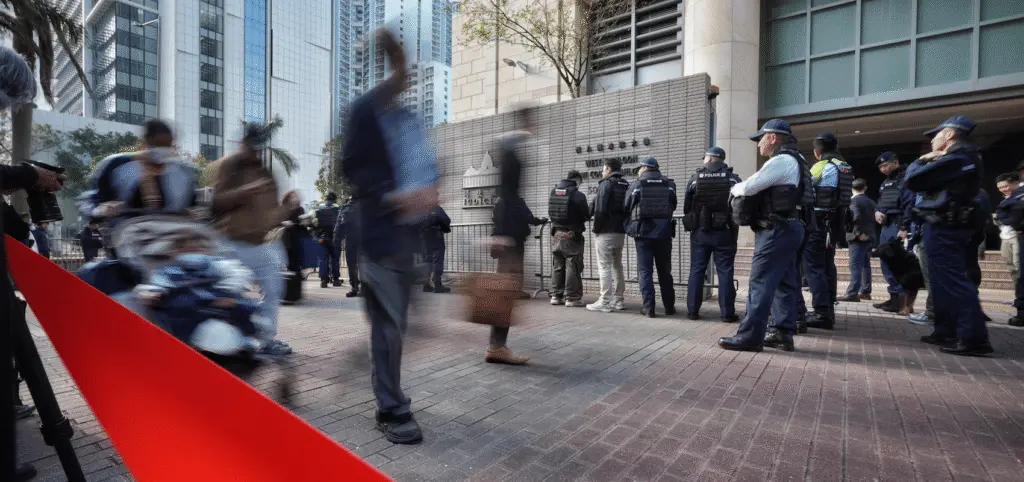
Seventy-eight years old, diabetic, and confined to a maximum-security solitary confinement cell, Jimmy Lai endures a sentence that has lasted for well over 2,200 days. Allowed a mere fifty minutes of exercise per day, the billionaire-entrepreneur-turned-political-prisoner occupies a stark reality constructed by the machinery of Chinese state security. Convicted in what international observers, human rights organizations, and legal experts widely condemn as a sham trial orchestrated to suppress dissent and criminalize journalism, Lai faces the prospect of dying behind bars.
Yet, when asked whether the staggering cost of his resistance is worth it, his response transcends the secular vocabulary of political protest: "Yes, for the glory of God."
Lai’s journey from a media mogul heading Next Digital and Apple Daily to an isolated prisoner of conscience represents one of the defining moral and geopolitical struggles of the twenty-first century. This comprehensive report examines the trajectory of his imprisonment, the theological and historical framework of his endurance—specifically the ancient Christian concept of "white martyrdom"—and the agonizing parallel suffering of his family, including his daughter Claire, who faces a rigorous battle with lymphoma.
Read Also
As global diplomatic efforts stall, and despite past interventions by Western administrations, Lai’s fate remains an urgent test of international resolve. More deeply, it poses a profound challenge to the global Church and the international community regarding the cost of fidelity to human dignity, freedom of speech, and truth under authoritarian rule.
Detailed Chronology: From Media Mogul to Prisoner of Conscience
The systematic dismantling of Jimmy Lai’s freedom did not occur in a vacuum; it was the centerpiece of Beijing’s campaign to extinguish the historic liberties of Hong Kong following the implementation of the National Security Law (NSL) in June 2020.
The Seeds of Resistance and the Choice to Stay
For decades, Lai operated as a thorn in the side of the Chinese Communist Party (CCP). Born in mainland China, he fled to Hong Kong as a stowaway on a fishing boat at age twelve, working in garment factories before building Giordano, a successful multinational clothing retailer. Later, he founded Next Media and Apple Daily, a fiercely pro-democracy newspaper that became a vital voice for civil liberties in the territory.
When Beijing imposed the National Security Law—effectively ending the "One Country, Two Systems" framework—foreign governments and associates urged Lai to flee. Holding British citizenship, he had viable paths to safety abroad. Instead, Lai made the deliberate choice to remain in Hong Kong. He understood precisely what awaited him. He recognized that leaving would signal an abandonment of the staff, readers, and principles he had championed for decades.
Arrests, Raids, and the National Security Law
- August 2020: Lai was arrested under the newly minted National Security Law, alongside several executives from Next Digital. Police raided the Apple Daily newsrooms, carting away boxes of journalistic material in a move that signaled the death knell for a free press in Hong Kong.
- December 2020: After brief periods of bail that were repeatedly revoked under intense pressure from mainland authorities, Lai was remanded into custody. He was denied bail on national security grounds—a standard departure from Hong Kong’s traditional common law presumption of innocence.
- 2021–2023: Lai faced a barrage of politically motivated prosecutions, ranging from participating in unauthorized pro-democracy assemblies (including vigils commemorating the victims of the 1989 Tiananmen Square massacre) to alleged fraud charges concerning the lease of Apple Daily’s headquarters. Meanwhile, Apple Daily was forced to shutter its operations in June 2021 after its assets were frozen by authorities, leaving hundreds of journalists unemployed and the city’s independent media landscape eviscerated.
- Late 2023 to Present: The long-delayed national security trial commenced, characterized by closed-door maneuvers, the denial of Lai’s choice of legal representation, and the deployment of handpicked judges. The proceedings transformed into a judicial theater designed to criminalize standard journalistic practices, editorial decision-making, and peaceful communication with foreign lawmakers as "collusion with foreign forces."
Today, Lai languishes in solitary confinement, subjected to severe physical isolation that medical experts warn is hazardous for a man of his advanced age and diabetic condition.
Supporting Context & Metrics: The Anatomy of Repression in Hong Kong
To fully understand Jimmy Lai’s situation, one must examine the broader metrics of democratic decline and religious freedom suppression in Hong Kong since 2020.
+--------------------------------------------------------------------------+
|                 HONG KONG POST-2020 DEMOCRATIC EROSION                   |
+--------------------------+-----------------------------------------------+
| Metric                   | Status / Impact                               |
+--------------------------+-----------------------------------------------+
| Dissolved Civil Organs   | Over 60 civil society groups, trade unions,   |
|                          | and human rights NGO's forced to disband.     |
+--------------------------+-----------------------------------------------+
| Imprisoned Activists     | Estimated 1,500+ political prisoners and      |
|                          | detainees held under the National Security Law.|
+--------------------------+-----------------------------------------------+
| Independent Media Outlets| Virtually eradicated (Apple Daily, Stand News, |
|                          | Citizen News all forced to close).            |
+--------------------------+-----------------------------------------------+
| Freedom House Score      | Hong Kong's status downgraded from "Partially |
|                          | Free" to "Not Free," with sharp declines in   |
|                          | political rights and civil liberties.         |
+--------------------------+-----------------------------------------------+
The Theological Framework: Understanding "White Martyrdom"
In his writings smuggled from prison and shared with confidants, Lai has described his incarceration not merely as an ordeal to be survived, but as a spiritual transformation. He has written that he has "found prison a holy sanctuary with God" and that he is "actually most grateful to God for [having] put me through this suffering in order for me to get closer to His presence." He accepts his unjust imprisonment as "a joy and treasure for this life and the next."
This perspective invites a profound theological reflection. In contemporary secular discourse, a "martyr" is strictly defined as someone who dies for their faith—what the Christian tradition terms a "red martyr." However, ancient Christian history offers a more nuanced taxonomy of sacrifice.
A seventh-century Irish homily outlines three distinct categories of martyrdom:
- Red Martyrdom: The literal shedding of one’s blood in fidelity to Christ and His teachings.
- Green Martyrdom: The internal ascetic discipline through which a person frees themselves from evil desires via fasting, labor, and deep repentance.
- White Martyrdom: The complete abandonment of everything one loves for God’s sake, enduring prolonged labor, isolation, social death, and systemic persecution without shedding blood.
Historical precedents illustrate how white martyrdom often serves as the crucible for red martyrdom. Consider the Blessed Ulma family of Poland, who lived a prolonged white martyrdom by risking their lives and security to shelter Jewish families during the Nazi occupation. Their quiet, daily courage ultimately culminated in red martyrdom when they were massacred by Nazi forces in 1944—an act of ultimate sacrifice that led to their beatification by the Catholic Church in 2023.
Jimmy Lai stands today as Catholicism’s most prominent living white martyr. Because Chinese dictator Xi Jinping and the apparatus of the CCP view his enduring moral clarity as an existential threat, the boundary between his current white martyrdom and potential red martyrdom grows increasingly thin. Should he die in the harsh confines of his maximum-security cell, he will join the historic catalog of witnesses who chose truth over preservation.
Official Statements and International Response
The plight of Jimmy Lai has galvanized international human rights organizations, legal scholars, and foreign governments, though diplomatic leverage has thus far proved insufficient to compel Beijing or the Hong Kong administration to relent.
Diplomatic Interventions and Condemnations
Western nations, including the United States, the United Kingdom, and members of the European Union, have repeatedly condemned the prosecution of Jimmy Lai as a direct violation of the Sino-British Joint Declaration and international human rights covenants.
- The United States: Successive U.S. administrations, alongside bipartisan members of the U.S. Congress, have called for Lai’s immediate and unconditional release. Lawmakers have introduced resolutions condemning the weaponization of Hong Kong’s judiciary and urged economic and diplomatic sanctions against officials responsible for human rights abuses in the territory.
- The United Kingdom: As a British citizen, Lai has been the focus of sustained advocacy by UK parliamentarians. However, diplomatic efforts by London have faced stonewalling from Beijing, which rejects foreign intervention in what it terms its internal legal affairs.
- United Nations Experts: Various UN special rapporteurs have issued statements declaring that Lai’s detention and trial violate international standards of fair trial, freedom of expression, and due process, calling the National Security Law a tool of systemic repression.
The Contrast in Ecclesial Solidarity
While international political bodies have voiced concern, the response from religious leadership has revealed painful fractures.
On one side stands the indefatigable Cardinal Joseph Zen, the 94-year-old Bishop Emeritus of Hong Kong. Cardinal Zen has remained a steadfast pillar of support for Jimmy Lai and his family, refusing to be silenced by the climate of fear enveloping the local diocese. His courage contrasts sharply with the deafening silence and perceived complicity of the current leadership of the Diocese of Hong Kong. Observers have noted with dismay the default in solidarity from the present bishop of Hong Kong, who has largely steered clear of advocating for Lai or addressing the systematic erosion of religious and civil freedoms within his own flock.
This local institutional failure places an even greater moral imperative on the global Church. The communion of the worldwide Christian community is called to fill this vacuum, offering prayers, public advocacy, and unwavering moral support to Lai and his family.
The Lai Family: A Slow-Motion White Martyrdom
The burden of state repression rarely stops with the individual target; it radiates outward, enveloping families in a web of anxiety, grief, and endurance. Jimmy Lai’s wife, Teresa, and their children—Sebastien, Augustine, and Claire—are living out their own profound version of a slow-motion white martyrdom.
Separated from a husband and father by prison walls and geopolitical hostility, the Lai family has displayed extraordinary grace under fire. Their suffering was compounded exponentially when Claire, Lai’s daughter, was diagnosed with lymphoma.
Despite facing her own terrifying medical battle involving rigorous chemotherapy—a trial that tragically coincided with major health crises faced by global figures, including Pope Francis’s own surgeries—Claire’s thoughts remained anchored in compassion and faith. In correspondence shared during the darkest hours of her treatment, Claire expressed that she was actively praying for the healing of the Holy Father, embodying the very Gospel principles her father sacrificed his freedom to uphold.
From his solitary cell, Jimmy Lai demonstrated the same unwavering paternal and spiritual strength, writing to Claire in a letter that serves as a testament to defiant faith:
"My dearest daughter . . . be strong and trust the Lord’s salvation to save you from this. This is a trial and God sent you this trial for a reason, a reason beyond our comprehension but we must trust that . . . He must be preparing you to meet something important and good. For God does nothing in vain. . . . Let our Lord’s grace light up your heart [so] that you see the wisdom of this suffering. . . . Do not worry, be sure that God is beside you, looking over you and consoling you."
Unlike the Ulma family, whose clandestine heroism during World War II meant they suffered in relative isolation from global prayer networks, the Lai family is not alone. The global community bears witness to their pain.
Future Outlook: A Global Test of Conscience
As Jimmy Lai approaches his late seventies inside a solitary cell, the trajectory of his case points toward a sobering conclusion. With the Hong Kong judiciary fully subjugated to the political directives of the Chinese Communist Party, the likelihood of a fair legal exoneration is virtually nonexistent. Unless intense, coordinated geopolitical pressure forces Beijing to negotiate a humanitarian release or exile, Lai faces the distinct possibility of perishing behind bars.
This reality transforms his imprisonment into a litmus test for the international community. For democratic governments, failing to maintain relentless pressure on Beijing signals a dangerous acquiescence to the global expansion of authoritarian surveillance and judicial abuse. For the global Church, abandoning Jimmy Lai and his family to the shadows would mean ignoring a modern-day confession of faith unfolding in real-time.
The obligation before the international community is twofold:
- Diplomatic Persistence: Foreign ministries must continue to demand Lai’s immediate release, utilizing targeted sanctions against judges and prosecutors who subvert the rule of law in Hong Kong.
- Spiritual and Communal Solidarity: Believers and human rights advocates worldwide must amplify the plight of the Lai family, ensuring that their sacrifice is neither forgotten nor normalized by the passage of time.
In the final analysis, Jimmy Lai’s white martyrdom is not merely a personal tragedy; it is a radiant beacon of human dignity standing defiant against the dark mechanics of tyranny. Whether he achieves earthly liberation or meets his end within the cold walls of maximum security, his witness has already secured a place in the annals of history—a reminder that while oppressive regimes can cage the body, no amount of state power can shackle an unbroken spirit anchored in truth, faith, and freedom.


Comments
Facebook App ID not configured. Please add it in the Customizer.