In the sprawling, high-ceilinged expanse of her Bogotá studio, Doris Salcedo leans over a work table, a magnifying glass clutched in her hand, inspecting a dense, fibrous wall of human hair. At 67 years old, the internationally acclaimed Colombian artist is legally blind, a consequence of Stargardt disease, a rare genetic condition that began robbing her of her central vision when she was just 31. Yet, far from halting her practice, this profound physical transformation has catalyzed a radical evolution in her work, shifting her from the quiet solitude of solo production to the complex, symphonic coordination of a massive collaborative enterprise.
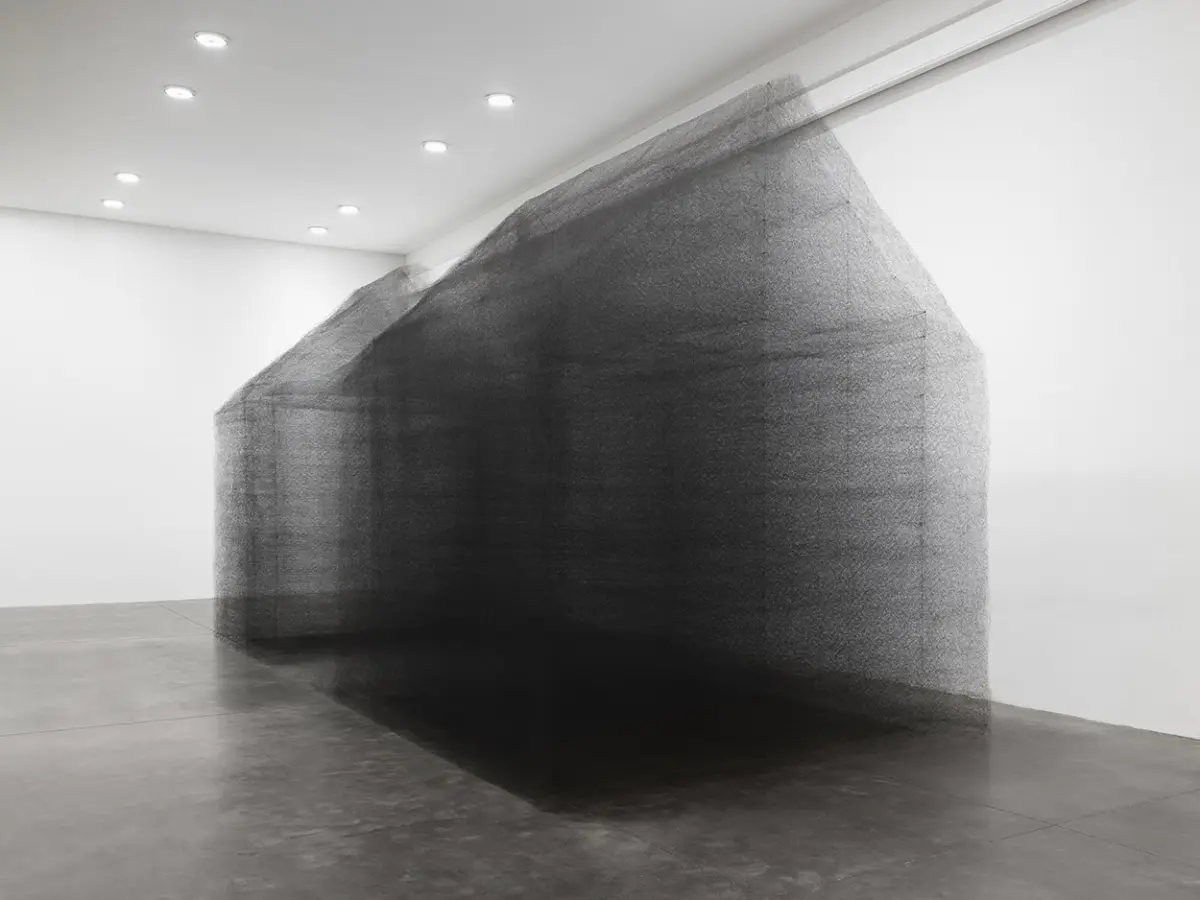
Salcedo is globally revered for her searing "anti-monuments"—gigantic, evocative artworks and negative spaces that radically rethink how human atrocities are commemorated. This November, at White Cube Gallery in New York, she will unveil the culmination of a three-year, highly intensive collaborative effort: a 30-foot-tall, full-sized house woven entirely from human hair. Alongside this monumental structure sits Grains of Sorrow (2023–26), an astonishingly delicate series comprising individual grains of rice meticulously stripped of their starch, bored through with minuscule holes, and threaded with hair to form protective meshes over damaged domestic cooking vessels.
These works form the cornerstone of Salcedo’s latest exploration into "domicide"—the calculated, systematic destruction of home environments in zones of contemporary conflict like Ukraine, Gaza, Syria, and Sudan. By pairing delicate, ephemeral materials with industrial-scale labor, Salcedo continues to challenge art-historical tropes, assert the foundational suffering of the Global South within modernity, and craft an unyielding visual vocabulary that demands the world refuse to look away from its deepest horrors.
Detailed Chronology: From Solitary Improv to the Studio Chorus
The Solitary Years and the Onset of Stargardt Disease
Before her vision began its irreversible decline, Salcedo operated as a quintessential solitary sculptor. Working entirely alone in her studio, she treasured what she has described as "the privacy of improvising and of working directly with the materiality." Working without preparatory drawings, she allowed intuition and physical interaction with wood, bone, and fiber to dictate the final form of her sculptures.
However, at age 31, the diagnosis of Stargardt disease introduced an impending shadow over her creative autonomy. As her central vision deteriorated, leaving only peripheral sight, Salcedo was forced to surrender her absolute independence "little by little."
[Age 31: Stargardt Diagnosis]
       │
       ▼
[Gradual Loss of Central Vision]
       │
       ▼
[Transition from Solitary Improvisation to Studio Collaboration]
       │
       ▼
[Architectural & Engineering Integration (Carlos Granada - 25-year partnership)]
       │
       ▼
[Monumental Scale: Shibboleth (2007) to Fragmentos (2018) to House (2026)]
Navigating the Transition to Collaboration
The psychological and procedural adjustment was arduous. "It was a very difficult adjustment, especially losing the privacy," Salcedo reflected during a studio visit in July. Because she could no longer rely on spontaneous, in-the-moment adjustments, she had to fundamentally restructure her cognitive approach to art-making.
"Before, I was improvising; I never had a prior drawing," she explained. Working with assistants meant that "things have to be absolutely defined." She had to devise clear, communicable plans for engineers, architects, and studio teams. Yet, this constraint unlocked an unprecedented artistic breakthrough. Over time, Salcedo realized that collective production yielded far more powerful results than a solitary voice. "It becomes like a chorus, and a really potent one," she noted, acknowledging that collaborative creation enabled pieces of a monumental scale that would have been physically impossible for one person to construct within a single lifetime.
Decades of Architectural and Monumental Milestones
Salcedo’s transition into monumental spaces has defined contemporary sculpture over the past two decades. Her landmark 2007 installation Shibboleth at the Tate Modern’s Turbine Hall materialized as a massive, scar-like crack running 548 feet across the concrete floor, physically disrupting foot traffic to evoke the violent ruptures of borders, racism, and colonial division.
In 2018, she realized Fragmentos, a permanent "anti-monument" commissioned by the Colombian government in Bogotá to mark the 2016 peace accord with the FARC guerrillas. Designed in collaboration with architect Carlos Granada—her close collaborator of 25 years—the structure utilizes textured floor tiles melted down from weapons surrendered by FARC combatants. Created in close partnership with 20 Colombian women who survived sexual violence during the conflict, Fragmentos subverts traditional victory monuments by forcing visitors to literally walk upon the instruments of past terror.
Supporting Context & Metrics: The Anatomy of Domicide and Labor
Materiality, Scale, and the Human Hair Trade
Salcedo’s upcoming White Cube exhibition centers on the concept of domicide—a term coined by geographers J. Douglas Porteous and Sandra E. Smith to describe the deliberate, systematic destruction of a home, resulting in the annihilation of community, security, and identity.
To give physical form to this psychological devastation, Salcedo turned to two profoundly vulnerable materials: human hair and rice. While she previously utilized hair on a micro-scale in works like Unland (1995–98)—where she threaded locks gathered from local salons through severed wooden tables—the sheer magnitude of House demanded an industrial approach. Sourced via online vendors, the hair required rigorous vetting:
Sourcing Logistics: Due to the illicit and frequently violent nature of the global human hair trade, Salcedo’s studio implemented strict certificate verification protocols.
Production Timeline: The weaving of the nearly 30-foot-tall house required a team of dozens of studio assistants working continuously for three years. Salcedo estimates that the undertaking would have required roughly 20 years if attempted entirely on her own.
Labor Force: The studio complex employs approximately 150 women from rural regions of Colombia, providing critical economic opportunities in areas where formal employment remains scarce.
┌─────────────────────────────────────────────────────────┐
│                  METRICS OF PRODUCTION                  │
├────────────────────────────┬────────────────────────────┤
│ Metric                     │ Value / Description        │
├────────────────────────────┼────────────────────────────┤
│ Height of 'House'          │ ~30 feet                   │
│ Production Duration        │ 3 Years                    │
│ Estimated Solo Timeline    │ ~20 Years                  │
│ Studio Workforce           │ ~150 Rural Colombian Women │
│ Architectural Partnership  │ 25 Years (Carlos Granada)  │
└────────────────────────────┴────────────────────────────┘
The Geopolitics of Labor and the Global South
Salcedo’s emphasis on intense, microscopic labor is not merely aesthetic; it is deeply political. By employing hundreds of rural workers to painstakingly strip starch from individual grains of rice with X-Acto knives, drill microscopic apertures, and weave human hair through them, she actively critiques the historical erasure of the Global South within canonical narratives of modernity.
"My work has always been labor-intensive because in the Global South, labor is intensive," Salcedo asserts. "It’s completely different from industrialized countries." She argues that dominant art-historical narratives often present modernity as an exclusively Western achievement, conveniently omitting the foundational suffering and manual extraction that enabled it. By binding European sculptural traditions with the exhausting, embodied labor of her studio team, Salcedo bridges the gap between historical exploitation and contemporary resilience.
Official Statements and Critical Perspectives
The Imperative of Beauty and Dignity
Salcedo’s integration of extraordinary elegance into harrowing subject matter has occasionally drawn critical scrutiny. Critics have questioned whether beautifying trauma risks sanitizing its political reality. Salcedo, however, rejects this dichotomy, maintaining that the abject nature of violence belongs strictly to the perpetrator.
"In all the violence and terror I’ve been researching all my life, I think the abject part belongs to the perpetrator. Beauty has a lot to do with dignity—something I want to restore as I tell the stories of victims."
— Doris Salcedo
By transforming human hair—an ephemeral biological byproduct—into a structural network as resilient as a spider’s web, Salcedo argues for the indomitable resilience of the displaced. Furthermore, she recognizes elegance as an essential tactical tool in contemporary media culture. In an era where news cycles saturate the public with continuous reports of mass displacement in Ukraine, Gaza, Syria, and Sudan, audiences frequently experience compassion fatigue. Salcedo employs aesthetic rigor precisely to disrupt this numbness, forcing viewers to pause, look closely, and confront global atrocities that they might otherwise scroll past.
Architectural Dialogues and Soundscapes
The physical architecture housing Salcedo’s vision reinforces her conceptual framework. Designed by Carlos Granada, her Bogotá studios feature high ceilings, glass brick walls, and floating staircases that maximize ambient light for her partially sighted assistants.
This spatial philosophy extends directly into her public projects. At Fragmentos, temporary installations consistently activate the site’s ruins. For instance, artist Hajra Waheed’s sound installation Hum II (2023) filled the courtyard with softly hummed songs of resistance broadcast through outdoor speakers. Derived from the Urdu word for "we," the installation united visitors across linguistic barriers, proving that Salcedo’s anti-monuments are living, breathing platforms for collective empathy rather than static historical markers.
Future Outlook
As Doris Salcedo prepares for her landmark autumn exhibition at White Cube Gallery in New York, her trajectory points toward an increasingly ambitious synthesis of scale, collaborative studio practice, and urgent geopolitical commentary.
The premiere of House and Grains of Sorrow marks a definitive maturation in her ongoing investigation into displacement and domicide. By bridging the micro-politics of individual bodily trauma—represented by individual strands of hair threaded through single grains of rice—with the macro-architecture of structural homelessness, Salcedo is redefining the parameters of monumental sculpture in the twenty-first century.
Looking forward, her model of cooperative studio production offers a compelling blueprint for aging master artists facing physical constraints: transforming vulnerability into a collective chorus. In doing so, Salcedo ensures that the memory of global atrocities is neither quietly buried nor easily ignored, but instead held up to the light with an unbreakable, breathtaking dignity.







Comments
Facebook App ID not configured. Please add it in the Customizer.