
Executive Overview
At the dead end of Louisiana Highway 66 sits the Louisiana State Penitentiary—universally known as "Angola" after the slave plantation that once scarred its marshy earth. Spanning 18,000 acres of penal farmland bordered on three sides by bayous, bluffs, and swamps, America’s largest maximum-security prison is an epicenter of state-sanctioned isolation, hard labor, and forgotten lives. Yet, within this landscape of razor wire and gun towers, human creativity has continually forced open cracks of light.
A powerful new wave of artistic reckoning is currently on display at the Grand Rapids Art Museum in Michigan. Through January 2027, the institution is hosting three concurrent solo exhibitions—Gary Tyler: Rebirth, Ray Materson’s Metamorphosis, and Julie Green’s monumental installation The Last Supper—that showcase art forged by or about individuals caught within the machinery of the United States carceral system.
Rather than functioning as a distant historical retrospective, these exhibitions arrive at a perilous cultural moment. As political discourse increasingly flirts with public spectacles of punishment—from debates over execution methods and livestreamed military tribunals to gamified depictions of border enforcement—these works demand a rigorous confrontation with empathy, state power, and human dignity. They ask a fundamental, unsettling question: Within a carceral apparatus designed to erase the individual, how is dignity measured, weaponized, or reclaimed?
Read Also
Detailed Chronology: Art, Resilience, and the Carceral State
The Long Road of Gary Tyler: From Angola to the Gallery Walls
To understand the depth of Gary Tyler: Rebirth, one must trace a timeline of systemic injustice spanning over five decades. In 1974, Gary Tyler was a seventeen-year-old high school student in St. Charles Parish, Louisiana, caught in the violent crucible of forced school desegregation. Amid a segregationist mob attack on a bus carrying Black students, a white student was shot and killed. Though evidence pointed overwhelmingly to his innocence, Tyler was wrongfully arrested, coerced, and ultimately railroaded by an all-white jury into a wrongful conviction and a death sentence.
Tyler arrived at Angola with his life abruptly stolen. Bound by swamp and bayou, physical escape was a fantasy, but psychological survival demanded an outlet. His grandmother had been a quilter; fabric, scraps, and thread could occasionally be found, bartered, or traded. Over more than four decades inside—including two harrowing stints on death row—Tyler honed his textile craft. What began as a personal coping mechanism evolved into a renowned practice. Craftswomen and visitors from across the American South would travel to Angola simply to catch a glimpse of the man quietly reshaping textile art behind bars.

"All that time, I never thought of myself as an ‘artist,’" Tyler reflected during the opening of his Grand Rapids exhibition. "I said, ‘Call me a hobbyist.’ Artists were people in galleries, people with an audience."
Tyler’s perspective shifted only after decades of tireless advocacy by civil rights icons—including Rosa Parks—finally culminated in his release in 2016. His soul, as he describes it, took flight the moment he stepped outside, and it has yet to descend. Works like Captivity, 1974 (2023)—drawn from a photograph taken by his brother one month after his arrest, showing Tyler wearing the exact clothes he had on when detained—anchor his retrospective in raw, historical memory. Other pieces capture fleeting moments of beauty, such as a quilt featuring a majestic great crane, reminiscent of the wildlife that frequently roosted in the wetlands surrounding Angola and occasionally landed in the prison yard.
Ray Materson’s Miniature Marvels of Survival
Running parallel to Tyler’s large-scale textile narratives is the intricate, microscopic world of Ray Materson. Imprisoned for a drug-fueled robbery involving a toy gun, Materson invented a medium born out of pure psychological necessity: palm-sized embroideries meticulously stitched by hand using the frayed threads of unraveled prison socks. Merging the raw texture of Americana with the precise scale of Renaissance miniatures, Materson’s needlework became his window to the cosmos.
His subjects range broadly from baseball to outer space, but his most breathtaking creations blend documentation with existential philosophy. In his undated Self-Portrait, Materson depicts himself sitting before a mirror, meticulously stitching the very piece the viewer is examining. Within the composition, a smaller Materson stitches an even smaller Materson down a receding tunnel of infinite reflection. Significantly, the thick black frame caging his face is woven from the exact same thread as the rest of the work—a subtle reminder that the barriers enclosing him are constructed from the same human fabric.
Julie Green’s The Last Supper: A Monument to State Killing
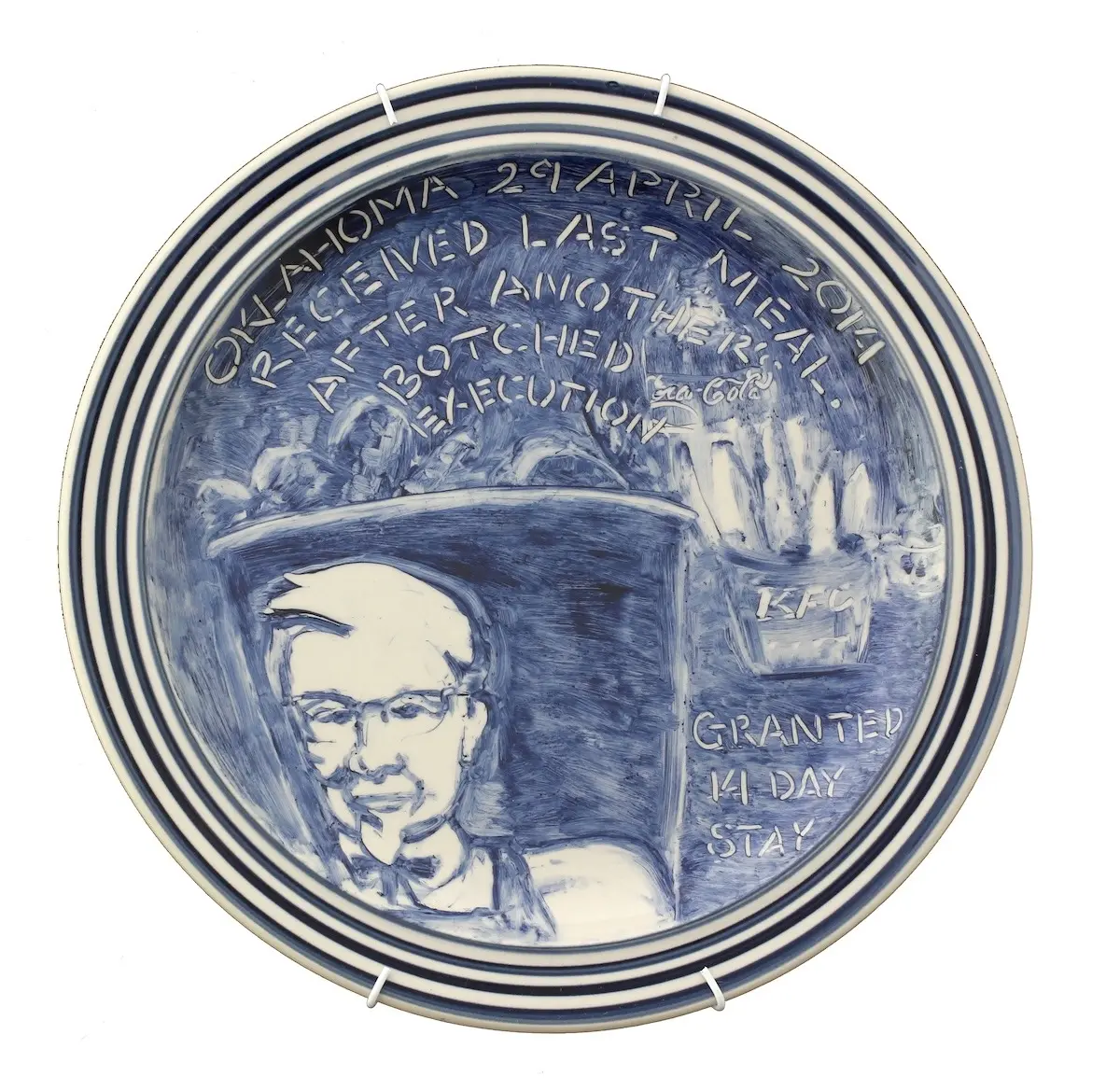
While Tyler and Materson utilize portraiture and narrative to assert individual humanity, the late artist Julie Green approached the carceral state through the chilling inventory of execution menus. The Last Supper, a staggering 1,000-piece ceramic installation shown in its entirety for only the second time, represents a twenty-year labor of love and grief. Up until her death in 2021, Green meticulously illustrated final-meal choices requested by death-row inmates on ceramic plates painted in cobalt blue and fired in her kiln.

At a glance, Green’s plates could easily be mistaken for traditional Staffordshire dinnerware. Upon closer inspection, however, the viewer confronts the stark, haunting reality of state-sanctioned death. The requests run the gamut of human craving and despair: an overflowing bucket of Kentucky Fried Chicken, lobster, steak, burgers and fries, pecan pie. Other plates record stark, bureaucratic rejections or refusals: prisoners who declined a meal, or states that denied a selection altogether.
The installation also maps the patchwork, often arbitrary nature of capital punishment laws across the United States. Following the Supreme Court’s 2002 ruling barring the execution of individuals with intellectual disabilities, states were left to establish their own criteria. One plate in Green’s collection records an executed inmate with an IQ of 61—well below the clinical benchmark of approximately 70—alongside a poignant final request: that his menu not be released to the media. Another records an inmate’s request that their meal be saved until after the execution.
Supporting Context & Metrics: The Scale of American Incarceration
To fully appreciate the significance of these art exhibitions, one must examine the macroeconomic and systemic scale of the United States penal complex.
- Mass Incarceration Footprint: The United States incarcerates more people per capita than almost any other developed nation, with approximately 1.2 million individuals currently held in state and federal prisons and local jails.
- The Legacy of Angola: Louisiana State Penitentiary houses roughly 6,300 incarcerated men on an 18,000-acre former slave plantation. Over 75% of those serving time at Angola are serving life sentences without the possibility of parole, meaning for the vast majority, the prison is both a home and a final resting place.
- The Economics and Spectacle of Punishment: Angola remains famous (and infamous) for hosting the Angola Prison Rodeo—the last remaining event of its kind in the nation. Held twice a year, it invites paying members of the public into the prison compound to witness high-risk events like "Convict Poker," where a raging bull is released into a ring of seated inmates. Despite legal prohibitions on gambling among spectators, the emotional stakes for the participating prisoners are profound.
As Gary Tyler’s 2025 quilt Convict Poker depicts—capturing a Black man suspended midair after being bucked by a bull—the event symbolizes the dangerous lengths to which incarcerated individuals will go to claim visibility. As Tyler notes, the men who volunteer do so not merely for sport, but because "they are willing to jeopardize their lives or go through a sense of degradation just to entertain an audience because nobody wants to be forgotten."
Official Statements and Curatorial Perspectives
The convergence of these three distinct bodies of work at the Grand Rapids Art Museum has sparked national conversations among curators, historians, and human rights advocates regarding the cultural messaging surrounding incarceration.

"It’s not so much that these shows are timely," explained Jennifer Wcisel, curator of collections at the Grand Rapids Art Museum. "It’s that the question of what incarceration means to American life is never absent. It’s ongoing."
Wcisel’s observation speaks directly to the broader sociopolitical climate. In recent years, public discourse surrounding crime, punishment, and state violence has witnessed a troubling normalization of retributive spectacle. From high-profile botched executions to official proposals for livestreamed military firing squads, the distance between the state’s mechanisms of execution and public entertainment has noticeably shrunk.
Art historians note that while historical portraiture was traditionally commissioned by the powerful to control public perception and project authority, the carceral art on display in Grand Rapids completely inverts this power dynamic. In prison, the powerful do the constant watching through surveillance cameras and armed guards. Yet, as Materson’s and Tyler’s works prove, surveillance can never capture the internal landscapes of its subjects. Insight cannot be forcibly extracted by the state; it can only be given freely by the artist.
Future Outlook: The Cultural Legacy of Carceral Art
As Gary Tyler: Rebirth, Ray Materson’s Metamorphosis, and Julie Green’s The Last Supper remain on view in Grand Rapids through January 2027, their institutional presence signals a vital shift in how mainstream cultural spaces engage with criminal justice issues.
The exhibitions challenge museums, collectors, and the general public to look past sanitized legal abstractions—such as sentencing guidelines, execution warrants, and population statistics—and confront the raw, individual humanity residing inside concrete and steel. By transforming discarded socks, scrap fabric, and dinner plates into profound testaments of endurance, artists like Tyler, Materson, and Green ensure that those whom the state attempts to render invisible are instead permanently etched into the cultural conscience.

Ultimately, these works do not merely aspire to match the volume of state-sponsored cruelty; rather, they serve as its antidote. By cultivating curiosity and radical empathy, they remind society that the true measure of a culture is not found in how effectively it cages and forgets its outcasts, but in how insistently its artists fight to preserve their humanity.




Comments
Facebook App ID not configured. Please add it in the Customizer.