
Executive Overview
The consumer technology landscape witnessed a seismic shift on November 6, 2026, with the official market launch of Apple’s 8th-generation iPad mini. Representing the most radical and comprehensive redesign in the product line’s storied history, the new tablet sheds its traditional boundaries to embrace cutting-edge display technology, unprecedented processing architecture, and polarizing structural engineering choices.
At its core, the 2026 iPad mini is powered by Apple’s formidable A20 Pro silicon, paired with a massive 12GB of RAM. This combination transforms what was once traditionally viewed as a casual media consumption device into a high-performance workstation capable of driving advanced, on-device Apple Intelligence workloads with absolute fluidity. Visual delivery has likewise entered a new era, anchored by an 8.5-inch Super Retina XDR OLED panel wrapped inside an ultra-slim 5.4 mm chassis.
However, engineering innovation rarely arrives without compromise. In its quest to achieve an IP67 water and dust resistance rating—a long-awaited durability milestone for the form factor—Apple completely eradicated physical speaker grilles in favor of an innovative, yet controversial, Acoustic Display architecture. Furthermore, despite its premium price point and gorgeous OLED canvas, the device remains capped at a traditional 60Hz refresh rate.
Read Also
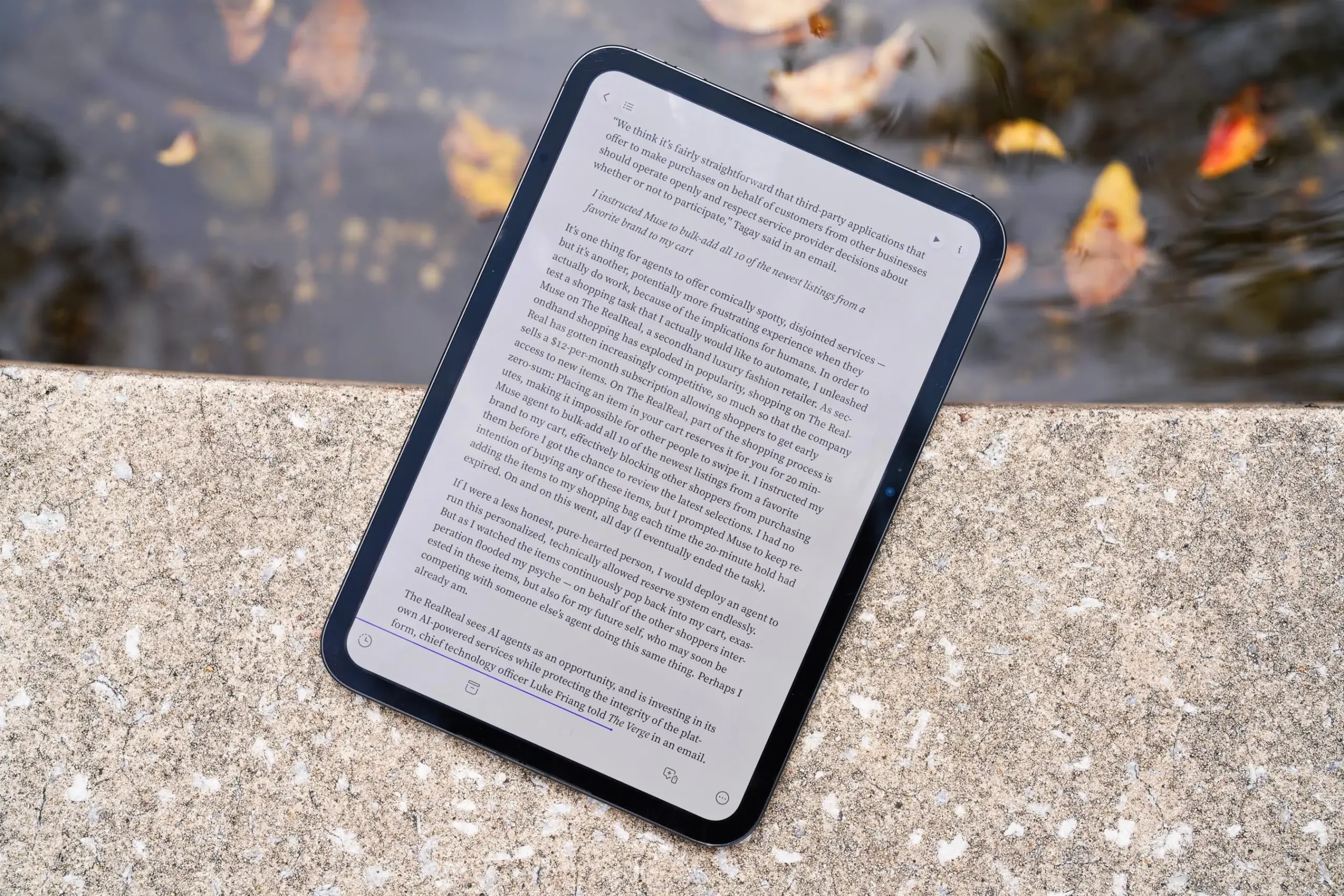
For digital readers, bibliophiles, and comic enthusiasts, the device introduces an intriguing optional upgrade: a matte nano-texture glass finish designed to banish glare entirely. This comprehensive review and investigative report explores the technical triumphs, design controversies, and reading ergonomics of Apple’s newest ultra-portable powerhouse.
Detailed Chronology
The Evolution Leading to November 2026
To fully understand the engineering leap represented by the 8th-generation iPad mini, one must examine the timeline of Apple’s compact tablet strategy over the preceding years.
- Late 2021 (6th-Generation Launch): Apple introduced a modern industrial design to the iPad mini lineup, featuring flat edges, a larger 8.3-inch LCD display, USB-C connectivity, and Apple Pencil 2 support. While widely praised, it suffered from notorious "jelly scrolling" issues due to screen refresh controller placement and lacked the high-end internals found in flagship devices.
- 2024–2025 (The Stagnation Gap): As competitors abandoned the sub-nine-inch tablet category entirely, Apple maintained market dominance by default, updating internals incrementally while consumers increasingly demanded superior screen technology and better outdoor readability.
- Early 2026 (Industry Leaks): Whispers emerged from supply chain analysts indicating that Apple was preparing a monumental overhaul for its smallest tablet. Rumors centered on the integration of OLED panels, ultra-thin manufacturing processes, and next-generation A-series processors.
- November 6, 2026 (Global Release): Apple officially released the 8th-generation iPad mini to global markets, immediately sparking intense industry debate over its radical structural changes, acoustic innovations, and pricing architecture.
Supporting Context & Metrics
Hardware Specifications and Performance Metrics
The architectural specifications of the 2026 iPad mini place it in a performance tier that rivals—and in some cases exceeds—traditional laptop configurations of just a few years ago.
| Feature / Specification | 7th-Generation iPad Mini (Previous) | 8th-Generation iPad Mini (2026) |
|---|---|---|
| Release Date | September 2021 | November 6, 2026 |
| Processor | A15 Bionic | A20 Pro Chip |
| **RAM Configuration |
| 4GB / 8GB (depending on variant) | 12GB unified RAM |
| Display Type | Liquid Retina (IPS LCD) | Super Retina XDR OLED |
| Display Size | 8.3 inches | 8.5 inches (24% smaller bezels) |
| Peak Brightness | 500 nits | 1,200 nits (HDR) |
| Chassis Thickness | 6.3 mm | 5.4 mm |
| Durability Rating | None official | IP67 Water & Dust Resistance |
| Audio System | Stereo Speakers (Physical Grilles) | Acoustic Display (Vibration-based) |
| Refresh Rate | 60Hz | 60Hz** |
The Visual Transformation: OLED Arrives in Miniature
The transition from IPS LCD to a Super Retina XDR OLED panel fundamentally alters the iPad mini user experience. Measuring 8.5 inches diagonally due to a 24% reduction in surrounding black bezels, the screen achieves absolute blacks, infinite contrast ratios, and a striking 1,200 nits of peak HDR brightness.
For media consumption, HDR video playback, and digital art creation, the visual fidelity is breathtaking. Colors possess a vibrant saturation without feeling oversaturated, and the elimination of backlight bleed makes dark-room reading and movie watching significantly more immersive.
Yet, a glaring specification omission remains: the display refresh rate is locked at 60Hz. At a time when consumers have grown accustomed to 120Hz ProMotion technology across Apple’s iPhone Pro and iPad Pro lineups—and increasingly on mid-range Android alternatives—the decision to stick with 60Hz on a premium-priced 2026 device has drawn heavy criticism from tech reviewers and power users alike. Scrolling through text-heavy web pages or fast-moving documents reveals subtle motion blur that contrasts sharply with the lightning-fast processing power delivered by the A20 Pro chip.
Processing Prowess: The A20 Pro and 12GB RAM
Underneath the ultra-thin 5.4 mm aluminum chassis beats the heart of an elite mobile workstation. The inclusion of the A20 Pro chip, paired with an expansive 12GB of unified RAM, obliterates computational bottlenecks.
This hardware configuration was specifically engineered to support heavy local processing demands. Apple Intelligence—the suite of generative AI features, writing tools, and contextual personal intelligence models—operates entirely on-device with zero cloud latency. Multitasking between resource-intensive applications, rendering complex 3D assets, and playing graphically demanding AAA gaming titles is handled with effortless thermal management and speed.

Official Statements and Industry Insights
The Engineering Trade-off: IP67 and the Acoustic Display
Achieving an IP67 water and dust resistance rating on a tablet as thin as 5.4 mm required extreme architectural gymnastics from Apple’s hardware engineering teams. Traditional speaker cavities and port grilles represent structural vulnerabilities that compromise water ingress protection.
To resolve this, Apple eliminated physical speaker grilles entirely, pioneering an Acoustic Display system. This mechanism utilizes specialized actuators to vibrate the OLED glass panel itself, projecting audio directly outward toward the user.
Industry reactions to this structural shift have been sharply divided.
"The Acoustic Display is a triumph of space-saving engineering that finally brings peace of mind against poolside splashes and kitchen spills via IP67 certification," notes industry analyst reports. "However, purists will immediately notice the acoustic trade-off. At higher volume thresholds, users can feel a tangible, physical vibration buzzing against their fingertips holding the device. Furthermore, it lacks the spatial depth, resonance, and warmth provided by dedicated acoustic speaker chambers."
The Reader’s Perspective: Nano-Texture Glass and Digital Publishing
For the substantial demographic of users who purchase tablets primarily as portable digital libraries—reading books, manga, graphic novels, academic papers, newspapers, and magazines—the 2026 iPad mini presents a compelling value proposition.
Apple has addressed outdoor readability by offering an optional matte nano-texture glass finish for an additional $150, available exclusively on the 256GB and 512GB storage tiers. Unlike standard glossy glass, which acts as a mirror under harsh overhead lighting or direct sunlight, the nano-texture glass is precision-etched at a nanometer scale. It scatters ambient light rays, effectively eliminating glare and closely mimicking the paper-like, matte tactile properties of dedicated E Ink e-readers.
Digital reading apps such as Apple Books, Kindle, and Kobo benefit immensely from this hardware upgrade. Because mobile application developers frequently target iOS as their flagship development platform, new features, advanced typesetting tools, and UI enhancements consistently debut on the iPad ecosystem long before reaching Android counterparts.
Furthermore, the ability to seamlessly purchase digital content directly within applications like Kindle and Kobo maintains a frictionless user experience that closed ecosystem competitors often lack. Weighing less than its predecessors and boasting a sleeker profile, the 8th-generation device is arguably the most portable high-resolution reading tablet ever manufactured.
Future Outlook
What Lies Ahead for Apple’s Compact Tablet Lineup?
As the dust settles on the November 2026 release of the 8th-generation iPad mini, market watchers are already analyzing the long-term trajectory of the sub-nine-inch device category.
- Adoption Curves and Market Response: Early sales metrics indicate robust demand among enterprise field workers, aviation professionals, and avid digital readers who prioritize maximum portability. However, the premium pricing tier—especially when factoring in upgrades like nano-texture glass and higher storage configurations—may relegate the device to a niche luxury status rather than a mass-market impulse buy.
- The Refresh Rate Dilemma: Consumer pressure regarding display refresh rates will likely force Apple’s hand in future iterations. Should mid-range tablets across the industry universally adopt 120Hz panels, Apple will be hard-pressed to maintain a 60Hz ceiling on a device marketed with the "Pro" moniker in its processor tier.
- The Future of Audio Engineering: The success of the Acoustic Display system on the iPad mini will dictate whether Apple expands vibration-driven audio into other ultra-thin form factors, such as future foldable devices or ultra-slim MacBook chassis. If consumer feedback critiques the tactile finger-vibration at high volumes, engineers may need to iterate toward hybrid acoustic solutions in subsequent generations.
Conclusion
The 2026 Apple iPad mini is an exercise in extreme engineering contradictions. It pairs arguably the most advanced silicon and display technology ever crammed into a compact chassis with controversial design choices regarding audio output and display refresh rates.
For casual readers, mobile professionals, and tech enthusiasts willing to navigate its trade-offs, it delivers an unmatched combination of raw processing power, AI integration, stunning OLED visuals, and reading comfort. Whether its bold compromises become the new industry standard or remain a fascinating one-off experiment will be decided by the consumers who vote with their wallets in the months ahead.



Comments
Facebook App ID not configured. Please add it in the Customizer.