
Executive Overview
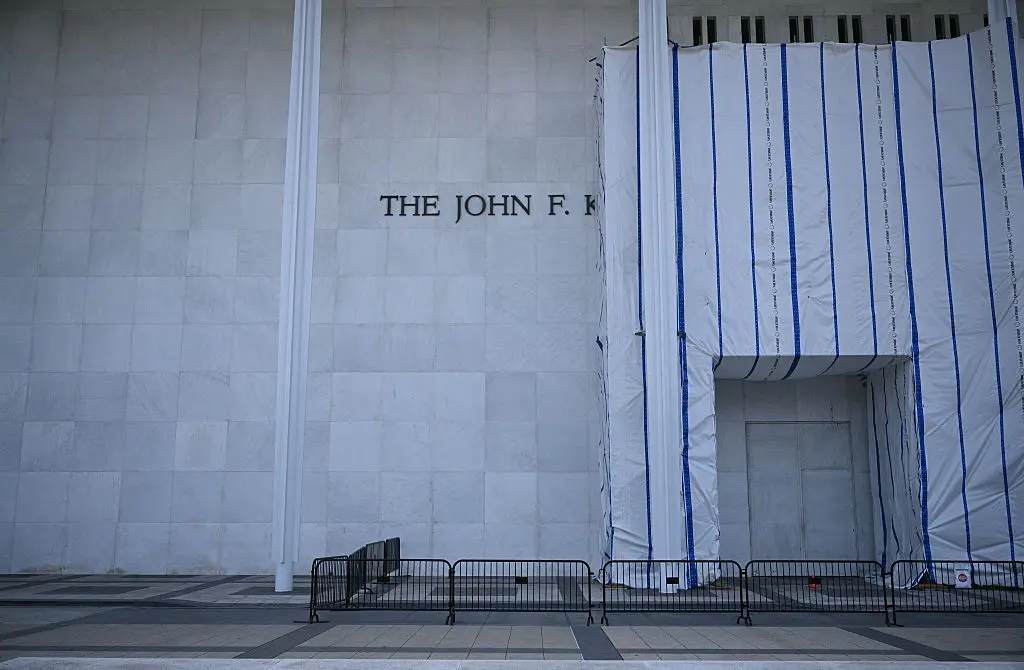
The long-standing cultural and legal controversy surrounding the transformation of the nation’s premier cultural institution entered a critical phase on Thursday, when a federal court received an emergency appeal aimed at permanently halting plans by the John F. Kennedy Center for the Performing Arts to engrave President Donald Trump’s name onto its iconic white marble facade.
The emergency filing—spearheaded by Representative Joyce Beatty (D-OH), an ex officio member of the center’s board of trustees—argues that the board’s recent actions constitute a willful and "clear violation" of an existing federal court order. The legal maneuver is the latest salvo in a high-stakes, multi-front battle involving federal judges, congressional mandates, preservationist watchdogs, and a fiercely loyal board of trustees appointed largely by the Trump administration.
At the heart of the dispute is a board-approved resolution to add an inscription reading "The John F. Kennedy Center for the Performing Arts Restored and Renovated By President Donald J. Trump" directly beneath the building’s primary signage. A secondary inscription—"Endowed by the Trump Kennedy Center Fund"—is contingent upon a newly established fundraising vehicle reaching a $100 million threshold. Critics, including congressional Democrats and Washington D.C. preservationists, assert that these maneuvers violate the foundational statutory framework established by Congress in 1964, which designated the institution as a living federal memorial to the assassinated thirty-fifth president, John F. Kennedy.
Read Also
Compounding the tension, this cultural showdown is unfolding parallel to other dramatic structural transformations across the nation’s capital, including the expedited construction of a controversial $400 million ballroom on the grounds of the White House. Together, these developments represent an unprecedented intersection of executive authority, historical preservation, and federal architecture that continues to polarize lawmakers, legal scholars, and the public.
Detailed Chronology of the Controversy
To fully understand the gravity of Thursday’s emergency appeal, it is necessary to examine the cascading series of votes, judicial rulings, and legislative maneuvers that have defined the controversy over the past year.
December 2023: The Initial Board Vote
The controversy originated in December 2023, when the Kennedy Center board—bolstered by a majority of Trump loyalists and allies—voted to integrate President Trump’s name into the institution’s branding and physical architecture. The proposal immediately triggered alarm bells among federal preservationists and historians, who pointed out that the center operates under unique federal protections. Legal experts quickly warned that modifying the memorialized name of a federally designated monument without express congressional approval would run afoul of the statutes passed in the wake of President John F. Kennedy’s 1963 assassination.
May 2024: The First Judicial Intervention
As plans for a controversial two-year closure for extensive renovations advanced, opponents of the rebranding took the matter to the U.S. District Court for the District of Columbia. In May, U.S. District Judge Christopher Cooper delivered a decisive ruling against the board. Judge Cooper determined that the trustees lacked the legal authority to rename or co-brand the institution, emphasizing that because Congress dedicated the facility in 1964 as a living memorial to President Kennedy, any formal alteration of its identity requires explicit congressional authorization. Furthermore, Judge Cooper found the board’s approval of a sweeping two-year facility closure to be unlawful, citing procedural overreaches and a lack of fiduciary transparency.
Early September 2024: The Rebranding Resurfaces
Despite Judge Cooper’s May injunction, the board reconvened earlier this month and formulated a revised strategy. Rather than officially "renaming" the center—which had been explicitly struck down by the court—the board voted to engrave President Trump’s name onto the facility’s exterior marble facade alongside language crediting him with the building’s restoration.
In addition to the primary plaque, the board established the "Trump Kennedy Center Fund." According to board resolutions, if this dedicated vehicle successfully secures $100 million in private and allied contributions, the institution is obligated to approve a second prominent inscription: "Endowed by the Trump Kennedy Center Fund."
Thursday, September [Current Month]: The Emergency Appeal
Responding swiftly to the board’s renewed efforts, legal representatives for Representative Joyce Beatty filed an emergency appeal in federal court on Thursday. The motion requests immediate judicial intervention to block the physical engraving of the building, which board representatives previously indicated would not commence prior to September 8, thereby granting the court a narrow window to review the competing legal briefs.
Supporting Context & Metrics: Finance, Architecture, and Law
The debate over the Kennedy Center is underpinned by competing philosophies regarding historical preservation, executive power, and institutional solvency.
The Financial Argument from the Board
Proponents of the board’s actions—including allies of the president serving as trustees—have defended their decisions through the lens of economic necessity and administrative pragmatism. In formal resolutions supporting the inscriptions, the board asserted that the institution "would be in financial ruin without President Trump’s unique stature as both an unparalleled fundraiser and world-class developer."
According to board metrics, the center faced mounting operational deficits compounded by post-pandemic recovery challenges. Supporters argue that leveraging the president’s brand and his purported fundraising prowess is not merely an act of recognition, but a vital fiscal lifeline necessary to fund tens of millions of dollars in deferred maintenance and infrastructure upgrades.
The Preservationist and Statutory Counterweight
Conversely, preservationists and constitutional scholars argue that financial exigency cannot override statutory law. The Kennedy Center was established through the National Cultural Center Act of 1958 and later designated by Congress in 1964 as the official national memorial to President John F. Kennedy, backed by federal funding and oversight.
Legal scholars specializing in federal property and historic preservation emphasize that national memorials occupy a distinct legal category. Unlike private museums or corporate-sponsored performing arts venues, federal memorials are held in public trust. Altering their physical fabric to honor a contemporary sitting or former political figure without legislative consent establishes a controversial precedent that bypasses the checks and balances inherent in congressional oversight.
Official Statements and Legal Postures
The public relations and legal battle lines have been drawn sharply between congressional critics and the institution’s leadership.
- Representative Joyce Beatty and Legal Counsel: In statements submitted to The Hill and other outlets, legal representatives for Rep. Beatty characterized the board’s latest maneuvers as a blatant defiance of judicial authority. "The board’s actions represent clear violations of a prior court order," her legal team asserted, emphasizing that the attempt to circumvent Judge Cooper’s May ruling via facade engravings and tiered fundraising milestones is an unconstitutional end-run around the judiciary.
- The Kennedy Center Administration: In communications with media watchdogs, representatives for the Kennedy Center maintained a cooperative yet firm stance regarding the timeline of the physical alterations. The institution confirmed that no physical masonry or inscription work would take place before September 8, providing the federal court adequate time to weigh the merits of the emergency appeal and the interpretations of the May injunction.
- The Trump Administration and Board Allies: Defenders of the board maintain that the planned inscriptions do not constitute a "renaming" of the institution—which was prohibited by Judge Cooper—but rather a legitimate historical acknowledgment of restoration work and financial endowment. They argue that recognizing major philanthropic contributions and capital improvements has long been standard practice across American cultural institutions.
Future Outlook and Broader D.C. Implications
As the federal court prepares to rule on Representative Beatty’s emergency appeal, the implications of this legal confrontation extend far beyond the banks of the Potomac River.
The case serves as a major test of judicial enforcement regarding executive-appointed boards and independent federal memorials. Should the federal court uphold the emergency block, it will reinforce the primacy of congressional statutes in governing national monuments against the unilateral desires of administrative boards. Conversely, if the court permits the inscriptions to proceed under the banner of philanthropic recognition, it could open the door to a new era of corporate and political co-branding across federal properties.
Meanwhile, the cultural disputes in the capital are not isolated to the Kennedy Center. Just blocks away, the legal and physical battle over the construction of a $400 million ballroom on the grounds of the White House has accelerated dramatically. Following a divided federal appeals court panel’s initial suspension of the project pending congressional review, the Supreme Court ruled on Friday that the construction may proceed. According to local Washington, D.C., media reports, construction crews are currently fast-tracking the White House East Wing demolition and subsequent ballroom development, operating grueling schedules of 20 hours a day, seven days a week, to ensure project completion.
As both the Kennedy Center facade dispute and the White House renovations hurtle toward their next legal and physical milestones, Washington finds itself at the center of an intense national debate over heritage, architectural alteration, and the boundaries of executive authority. All eyes now turn to the federal bench, where the immediate fate of the Kennedy Center’s historic marble facade hangs in the balance.



Comments
Facebook App ID not configured. Please add it in the Customizer.