
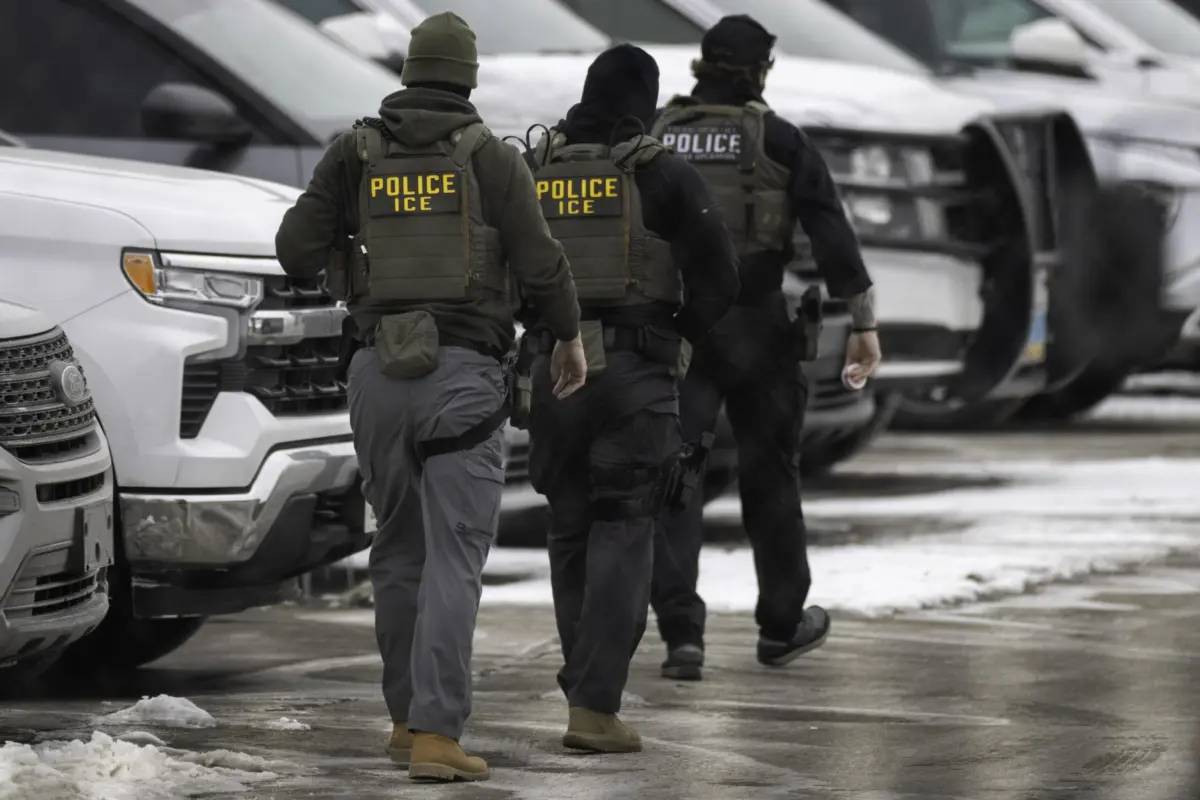
Executive Overview
For a brief and improbable moment in mid-2026, it appeared that the American legal system might hold a rogue federal law enforcement officer accountable for violent misconduct. Christian Castro, a now-suspended Immigration and Customs Enforcement (ICE) officer, found himself confined to a Texas jail cell facing a dual-prosecutorial onslaught. State-level prosecutors in Minnesota had secured an indictment against him, filing four felony counts of assault and one count of falsely reporting a crime following an early 2026 occupation and enforcement sweep in Minneapolis. Simultaneously, federal prosecutors were reportedly preparing to bring a criminal indictment under federal civil rights statutes.
To legal observers and advocates for civil rights, Castro’s impending prosecution felt like a watershed moment. It stood as a rare instance of a federal operative facing tangible consequences for alleged criminality committed during the aggressive, highly charged, and frequently violent wave of immigration raids orchestrated under the Trump administration.
Yet, within a matter of days, this momentum dissolved entirely. The federal civil rights charges mysteriously unraveled in Washington, D.C., in the final hours before filing, for reasons that remain entirely opaque. Meanwhile, Minnesota’s meticulously prepared extradition request was effectively nullified by a federal court decision. That ruling allowed Texas Governor Greg Abbott to run out the clock on a mandatory 90-day state statutory holding limit, culminating in Castro’s release from custody. Today, Castro sits beyond the immediate reach of Minnesota authorities, with whispers and indications pointing toward a potential flight to Mexico.
Read Also
This unfolding saga is not merely an isolated bureaucratic failure or a procedural hiccup. It represents a coordinated, multi-layered collision between defiant state executives, sympathetic federal judges, and a broader executive-branch ecosystem determined to ensure that immigration enforcement personnel operate above the law. If Christian Castro ultimately walks free without facing a jury, his impunity will be owed to an extraordinary coalition of state and federal actors who deployed every legal instrument at their disposal to shield him from accountability.
Detailed Chronology: From Minneapolis to Texas and Beyond
To understand how an ICE agent charged with multiple felonies managed to regain his freedom through legal maneuvers and interstate obstruction, it is necessary to retrace the timeline of events beginning in the bitter winter of early 2026.
The Minneapolis Incident
In January 2026, amid a tense federal enforcement surge in the Twin Cities, Christian Castro allegedly discharged his firearm through the front door of Julio Sosa-Celis’s Minneapolis home. The bullet struck Sosa-Celis in the leg, causing severe injury.
In the immediate aftermath, the official narrative put forth by the Trump administration attempted to paint the agents as victims. Federal spokespersons claimed that Sosa-Celis and his roommate had aggressively attacked ICE personnel with household implements, specifically a broom and a shovel. However, this foundational justification quickly evaporated. Prosecutors and independent investigators reviewed comprehensive video footage of the incident, which completely contradicted the official account, exposing the allegations of an armed assault on federal agents as entirely fabricated. Consequently, ICE suspended Castro without pay.
Indictment and the Interstate Standstill
Recognizing the gravity of the misconduct, the office of Minnesota Attorney General Keith Ellison and local prosecutors acted decisively. In May 2026, formal felony charges were filed against Castro. Because Castro routinely resided in Texas, Minnesota authorities secured an arrest warrant, leading to his apprehension in the Lone Star State.
Under the United States Constitution, this arrest should have triggered a straightforward administrative and legal mechanism. Article IV, Section 2, Clause 2 mandates that a person charged with treason, felony, or other crime who flees from justice and is found in another state shall, upon demand of the executive authority of the state from which they fled, be delivered up and removed to the state having jurisdiction. Accordingly, Minnesota Governor Tim Walz formally submitted a request for Castro’s extradition on June 2, 2026.
Instead of facilitating the constitutional transfer, Governor Abbott initiated a deliberate stalling campaign. Abbott’s administration claimed—on remarkably dubious legal grounds—that Castro might not legally qualify as a "fugitive from justice" because he relocated to Texas at the explicit direction of his federal employer. Simultaneously, Texas legal counsel rushed to federal court to block any judicial order compelling the state to comply with the Constitution’s extradition clauses.
The Federal Court Intervention
With a strict 90-day statutory limit governing how long Texas jails could hold an inmate awaiting interstate extradition without a gubernatorial rendition warrant, time was running out for Minnesota prosecutors. During his incarceration, intercepted communications revealed that Castro had engaged in numerous telephone conversations with his romantic partner in Mexico, explicitly discussing plans to permanently relocate south of the border should he secure his release.
Fearing imminent flight, Minnesota pushed for judicial intervention. However, on a crucial Wednesday in late August, Trump-appointed U.S. District Judge Fernando Rodriguez Jr. delivered an opinion in Walz v. Abbott that effectively endorsed Texas’s obstructionist strategy.
Judge Rodriguez’s ruling hinged on an extraordinarily deferential interpretation of executive delay. The opinion argued that it was premature for a federal court to order Abbott to execute the extradition because the governor had not yet formally and explicitly denied the rendition warrant. Instead, Rodriguez pointed to an internal investigation ordered by Abbott—tasking the Texas Secretary of State with probing whether Castro met the definition of a fugitive—and suggested Minnesota had to wait for this process to conclude.
This reasoning contained a glaring internal contradiction. In a revealing footnote, Judge Rodriguez acknowledged that Abbott’s investigation rested on a fundamentally baseless premise. The Supreme Court established the legal definition of a fugitive more than a century ago, and that standard explicitly includes individuals who cross state lines for employment reasons, federal or otherwise.
In effect, Judge Rodriguez ruled that Texas was legally permitted to ignore the U.S. Constitution’s extradition mandate based on a sham investigation into a settled legal question, and that it could drag its feet until state law forced Castro’s release. Castro walked out of the Texas jail a free man the following day.
Supporting Context & Metrics: The Erosion of Oversight
The collapse of the Castro prosecution does not occur in a vacuum. It reflects a systemic ideological alignment across multiple branches of government designed to insulate federal law enforcement personnel from civil liability and criminal prosecution.
- The Bivens Doctrine on Life Support: More than fifty years ago, the Supreme Court established in Bivens v. Six Unknown Named Agents (1971) that individuals victimized by federal officers violating Fourth Amendment protections could sue those agents directly for damages. Over the past decade, however, the Supreme Court’s conservative majority has systematically eviscerated this precedent. Landmark rulings such as Hernández v. Mesa (2020) and Egbert v. Boule (2022) have immunized border agents and ICE personnel from civil lawsuits if "any rational reason" can be imagined to justify shielding them. This docket will expand further as the Court hears Nielsen v. Watanabe, threatening to eradicate what little remains of individual civil accountability.
- The Shadow of In re Neagle: Even if Castro is eventually brought to Minnesota, state prosecutors face a formidable historical hurdle rooted in the 1890 Supreme Court case In re Neagle. That ruling protected a federal marshal from state murder charges after he killed a would-be assassin targeting a Supreme Court justice while performing official duties. While the recent 2025 decision in Martin v. United States narrowed Neagle—establishing that federal officers are only immune from state prosecution if their actions were "necessary and proper" in the discharge of federal responsibilities—the application of this rule remains vague. Should Castro stand trial in federal district court (as federal statute mandates for prosecuted federal agents), any appeal would proceed directly to the U.S. Court of Appeals for the Eighth Circuit, widely recognized as one of the most conservative appellate benches in the nation.
- Partisan Retaliation: The political animus driving these judicial and executive maneuvers was underscored immediately after Judge Rodriguez’s ruling. Governor Abbott took to social media platform X to openly mock Minnesota Attorney General Keith Ellison, characterizing Minnesota’s legal team as incompetent, labeling the state a "sanctuary state," and threatening to bus migrants from Texas to Minnesota.
Official Statements and Political Reactions
The standoff has triggered sharp rebukes from state leaders committed to the rule of law, contrasted with triumphalist rhetoric from conservative figures cheering the blockade of local prosecutors.
Minnesota officials have expressed deep alarm over the breakdown of interstate cooperation and constitutional norms. Attorney General Keith Ellison’s office maintained throughout the proceedings that the refusal of Texas authorities to honor a valid interstate rendition request sets a dangerous precedent that undermines the federal compact. By weaponizing administrative delays to assist an accused felon in evading justice, state leaders argue that Texas has effectively established a localized doctrine of nullification.
Conversely, federal immigration unions and state-level MAGA allies have rallied around Castro. Conservative legal commentators and officials have advanced the narrative that aggressive local prosecutors are engaged in politically motivated lawfare against federal agents attempting to secure the southern border and enforce federal mandates. Governor Abbott’s public posture frames his administration’s actions not as an obstruction of justice, but as a necessary defense of federal law enforcement officers against hostile state jurisdictions.
Future Outlook: Accountability at a Crossroads
The immediate future of Christian Castro’s criminal case remains exceptionally murky. Even if federal authorities decide to revive their dormant civil rights investigation, or if Texas eventually reverses course and attempts to execute a belated extradition, the practical hurdles are immense. Texas authorities would first need to locate and rearrest Castro—a task complicated by his demonstrated desire to flee to Mexico. If he succeeds in crossing the international border, Minnesota would be forced to initiate a formal extradition request through diplomatic channels with Mexico, a diplomatic and legal process that frequently spans years.
More broadly, the case of Christian Castro serves as a grim litmus test for the future of federal law enforcement accountability in the United States. It demonstrates that when federal political appointees, conservative state executives, and sympathetic federal judges act in concert, constitutional mandates like the Extradition Clause can be rendered functionally toothless.
If officers who allegedly fire through residential doors and subsequently fabricate official reports can evade trial through interstate gamesmanship and judicial foot-dragging, the promise of equal justice under the law becomes an empty abstraction. For the victims of police violence and the state prosecutors attempting to enforce basic criminal statutes, the road ahead is steep, uncertain, and heavily fortified against accountability.




Comments
Facebook App ID not configured. Please add it in the Customizer.