
Executive Overview
In the hyper-competitive modern literary marketplace, a novel’s survival hinges on a singular, razor-sharp element: the premise. Long before agents request a full manuscript, editors evaluate an acquisition proposal, or readers click "buy," they pose the ultimate, make-or-break question: What is it about?
Far more than a vague concept or an overstuffed synopsis, a powerful premise is the foundational load-bearing wall of a novel. According to Macmillan Publisher Jennifer Enderlin, a premise is succinctly defined as “a statement of character and conflict.” It is simultaneously a creative North Star for the author and a potent marketing tool for the industry.
Yet, many emerging writers struggle to distill their sprawling, multi-plot epics into a single, compelling sentence. Crafting a high-stakes premise is both an art and a mechanical science. By mastering the fundamental equation of character, goal, and conflict—and injecting visceral hooks and high stakes—authors can transform amorphous story ideas into unputdownable commercial successes. This comprehensive guide explores the mechanics of premise formulation, drawing on timeless storytelling frameworks, classic literary examples, and insights from seasoned novelists.
Read Also
Detailed Chronology: The Evolution of the Premise in the Writing Process
To understand how a premise functions, it is helpful to trace its evolution across the traditional timeline of writing a novel—from the initial spark of inspiration to final publication and marketing.
Phase 1: The Incubation and Seed Stage
Stories rarely arrive fully formed. Most writers suffer from an abundance of ideas rather than a drought. Inspiration can strike from anywhere: a striking headline in the morning newspaper, a haunting personal dilemma, an intriguing urban legend, or an unconventional character dynamic.
During this initial phase, the writer collects "springboards." These might include:
- A unique plot twist designed to shock the reader.
- An unusual setting or historical backdrop.
- A specific thematic question the author wishes to explore.
However, as vital as these springboards are, they do not yet constitute a premise. A plot is merely a sequence of events; a premise anchors those events to a specific human heart.
Phase 2: Structural Synthesis (The Formula)
Once a foundational idea is selected, the writer must transition from brainstorming to structural synthesis. This is where the raw elements are forged into a workable premise using time-tested storytelling frameworks. Rooted in dramatic theory dating back to Aristotle—and expanded upon in modern craft guides like Debra Dixon’s GMC: Goal, Motivation, and Conflict: The Building Blocks of Good Fiction—the core premise can be distilled into a reliable formula:
[Character] wants [goal] but [conflicting circumstance].
Alternatively, it can be framed around behavioral disruption:
[Character] wants [goal] but she must [do something completely out of her comfort zone] to achieve that goal.
By applying this formula, the writer forces disparate elements to collide, establishing immediate dramatic tension.
Phase 3: Extrapolation and Character Alignment
Arriving at a full premise requires extrapolating outward from known quantities. For instance, consider J.R.R. Tolkien’s approach in The Hobbit. If an author decides to write about a timid, comfort-loving homebody, they must immediately pit that character against a diametrically opposed goal and conflict.
What does a timid homebody want? A quiet life, safety, community, and predictable meals. What stops them? A wizard who drags them into a perilous, continent-spanning quest. The brilliance of the premise lies in the inherent gap between the protagonist’s comfort zone and the magnitude of the task ahead.
Conversely, an author might start with a plot-driven concept—such as a quest to defeat a great evil—and work backward: Who is the absolute least likely person to survive this journey? Who has the most to lose?
Phase 4: The Polishing and Marketing Phase
Once the manuscript is drafted, the premise undergoes its final evolution. It ceases to be merely a private writing exercise and transforms into a high-stakes commercial pitch. Used in pitch letters, book jacket blurbs, and marketing copy, a well-honed premise acts as a magnet, drawing in readers by appealing to primal psychological instincts.
Supporting Context & Metrics: The Anatomy of a Winning Premise
To deconstruct what makes a premise genuinely functional, writers must examine its core components through practical application.
The Thumbnail Sketch: Character Archetypes
Developing a compelling protagonist for a premise requires balancing specificity with archetypal resonance. While nuanced psychological depth is necessary for the actual novel, a premise relies on shorthand—often pairing a descriptive adjective with a profession or social role.
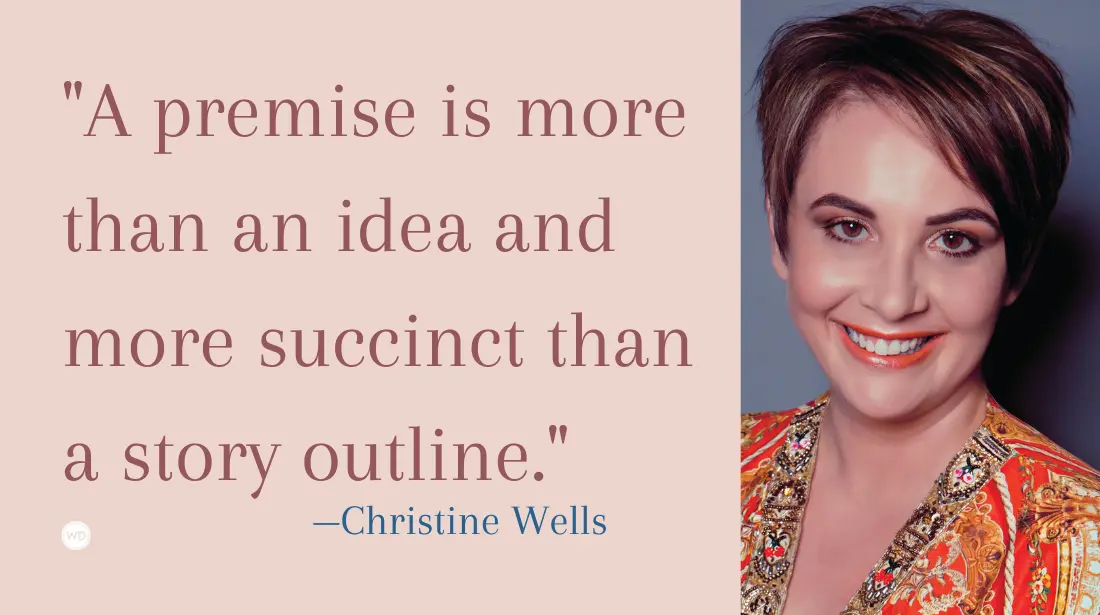
Consider Christine Wells’ historical novel, The Lost Perfumes of Paris. The protagonist can be effectively summarized as a career-focused chemist, Élodie Limeaux.
[Character]              + [Goal]                                  + [Conflict]
Career-focused chemist   + To win her dream of becoming a perfumer   + Forced to explore Paris with a
(Élodie Limeaux)           at the House of Limeaux                   distractive, attractive man to
                                                                     capture the city's true essence
In this structure, Élodie’s internal flaw—her single-minded tunnel vision that has prevented her from truly experiencing life—directly opposes the external requirement of her goal, creating organic, character-driven conflict.
Raising the Stakes: Size vs. Resonance
A common pitfall for developing writers is conflating "high stakes" with saving the universe. Many assume that an apocalyptic threat automatically generates reader investment. However, human beings do not connect with abstract global statistics; they connect with emotional stakes.
- The Tolkien Test: Had J.R.R. Tolkien chosen the seasoned warrior Aragorn as the primary hero of The Lord of the Rings, the emotional resonance would have altered drastically. Aragorn is an established hero with limited room for internal transformation. By centering the fate of Middle-earth on Frodo Baggins—the least likely, most vulnerable candidate—Tolkien maximized both the external peril and the internal stakes.
- Scale Flexibility: High stakes do not require cosmic destruction. Whether writing an epic fantasy or an intimate contemporary drama about a strained relationship over a cup of tea, the rule remains identical: If the goal is intensely vital to the character, it will become vital to the reader.
Appealing to the Id: The Psychological Hook
In an era saturated with competing entertainment media, books require a psychological hook to cut through the noise. Effective premises tap directly into the human id—the unconscious repository of primal desires. Readers are viscerally drawn to themes of:
- Survival and physical danger
- Mate selection and romantic longing
- The pursuit of power, wealth, and status
- Corruption, betrayal, and dark glamour
When a premise successfully triggers these core psychological fascinations, it bridges the gap between passive browser and active reader.
Official Statements and Industry Insights
Publishing professionals and master craftsmen have long emphasized that the strength of a book is directly tied to the clarity of its foundational premise.
Industry experts note that a weak premise often exposes a lack of structural integrity in the underlying plot. If an author cannot articulate their premise in a single, breathless sentence, the manuscript is frequently suffering from unfocused character motivation or insufficient conflict.
Furthermore, veteran workshop leaders point out that collaborative peer review is often the ultimate testing ground for a premise. When a writer pitches a concept to a room of fellow authors and elicits an audible gasp, that reaction serves as empirical market research. It signals that the premise has struck a universal chord, balancing novelty with high dramatic tension.
Future Outlook: The Premise as an Editing and Marketing Touchstone
As the publishing landscape continues to evolve through digital self-publishing, algorithm-driven marketing, and shifting reader attention spans, the role of the premise is more critical than ever.
- The Compass for Editing: Beyond its utility as a sales pitch, a killer premise serves as an invaluable editing touchstone. When a writer loses their way in the messy middle of a manuscript, returning to the core premise provides immediate clarity. It highlights precisely which narrative threads are extraneous (and must be ruthlessly cut) and which character arcs must be honed.
- The Digital Discoverability Anchor: In online retail environments where books are judged by thumbnail covers and brief book descriptions, a tightly formulated premise translates directly into effective ad copy and metadata hooks. Authors who master the art of the premise are better equipped to market their work across fast-paced digital platforms.
Conclusion: Your Call to Action
Whether you are plotting your very first manuscript or revising a completed draft, take the time to strip your story down to its foundational elements: [Character] wants [goal] but [conflicting circumstance].
Do not fear high stakes, big contrasts, or challenging your protagonist’s worst nightmares. By forging a powerful, unbreakable premise, you not only secure your book’s marketability—you build an unshakeable roadmap to a unforgettable novel.



Comments
Facebook App ID not configured. Please add it in the Customizer.