
Executive Overview
Literary fiction has long served as a mirror for humanity’s primal instincts, ancestral ghosts, and the psychological terrain where domestic life collides with untamed wilderness. Acclaimed author Abby Geni returns to this liminal space with her upcoming novel, Children of the Wolf, slated for publication by Ballantine Books on September 15, 2028. Known for her intricately plotted, environmentally resonant narratives—including The Body Farm, The Lightkeepers, The Wildlands, and The Last Animal—Geni has established herself as a formidable voice in contemporary American fiction.
A graduate of the prestigious Iowa Writers’ Workshop and an Iowa Fellowship recipient, Geni brings an uncompromising dedication to craft and structure to her latest endeavor. Children of the Wolf shifts the literary microscope toward Liv, a woman forged in the crucible of rural Iowa by a Swedish-born father consumed by his self-mythologized Viking heritage. When Liv relocates to Michigan, a series of mysterious disappearances forces her to unearth the buried trauma and violence of her upbringing.
In this comprehensive feature, we examine the anatomy of Geni’s writing process, the thematic architecture of her new book, the nuances of her collaboration with Ballantine editors Jennifer Hershey and Kate Gomer, and her authoritative philosophy on creative autonomy. Through exclusive interview insights, we trace the decade-long gestation of a novel designed not merely to be read, but to haunt its audience long after the final page.
Read Also
Detailed Chronology: From Inciting Inspiration to Publication Day
The trajectory of a masterwork is rarely linear. For Abby Geni, the journey of Children of Children of the Wolf* spans years of silent contemplation followed by an intense, accelerated burst of composition.
The Incubation Period: A Decade in the Mind
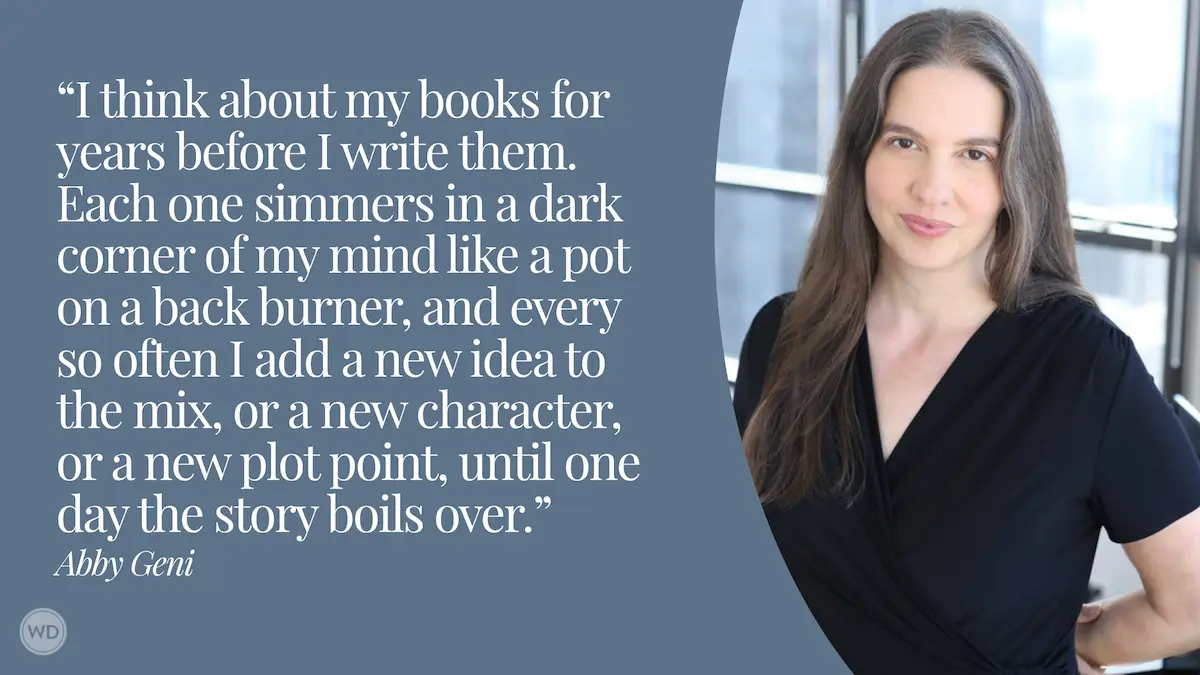
Geni’s creative process defies the conventional wisdom of continuous drafting. Instead, she operates on a model of protracted mental incubation. For Geni, every novel begins its life as a simmering pot on a back burner.
"I think about my books for years before I write them," Geni explains. "Each one simmers in a dark corner of my mind… and every so often I add a new idea to the mix, or a new character, or a new plot point, until one day the story boils over."
This long-form gestation allows the narrative ecosystem to balance itself naturally. By the time Geni sits down at the keyboard, the novel’s bones are entirely calcified. When asked how long it takes to write a book, her response is characteristically dual-layered: "Either a decade (thinking) or a year (putting words on paper)."
The Catalyst: Enter Ulf Thorvaldsson
The spark that finally forced the pot to boil over was an imposing, uninvited apparition in the author’s imagination.
"One day, Ulf Thorvaldsson, a seven-foot-tall, modern-day, Swedish-born Viking, tromped into my brain and stood there glowering at me until I began writing about him and his children," Geni recalls.
Ulf—the larger-than-life patriarch who instills an obsessive, mythic worldview in his children across the rural landscapes of Iowa—demanded narrative space. Around him crystallized the world of Liv, her brother Finn, and a narrative driven by inherited dogma and modern isolation.
The Publishing Journey with Ballantine Books
Once the manuscript was fully realized and transferred to paper, it found a home with Ballantine Books. The transition from manuscript acceptance under editors Jennifer Hershey and Kate Gomer to the scheduled release date spans approximately a year and a half.
Notably, this phase included strategic adjustments regarding positioning and marketing. Originally slated for a summer 2026 release, the publication schedule was recalibrated following insights from the publisher’s marketing division. Recognizing the atmospheric, chilling undertones of the narrative, the team decided that Children of the Wolf belonged to the literary tradition of haunting, autumnal reads rather than light summer fare—a thematic shift visually sealed by the novel’s striking, moody cover art.
Supporting Context & Metrics: A Literary Pedigree
To fully appreciate the weight of Children of the Wolf, one must contextualize Geni’s bibliography and critical standing within the contemporary literary landscape. Her previous works have consistently drawn critical acclaim, earning nominations, finalist placements, and prestigious awards across multiple genres.
Critical Milestones and Accolades
- The Body Farm: Longlisted for both the Joyce Carol Oates Prize and the Story Prize, establishing Geni’s facility with psychological suspense and human vulnerability.
- The Lightkeepers: Winner of the inaugural Chicago Review of Books Award for Best Fiction, cementing her reputation for blending ecological detail with narrative tension.
- The Wildlands: Finalist for the Los Angeles Times Book Prize, showcasing her ability to handle expansive, complex familial and environmental landscapes.
- The Last Animal: Finalist for the Orion Book Award, demonstrating a sustained commitment to humanity’s relationship with the natural world.
Thematic Constants: Ecology, Isolation, and Family Trauma
Geni’s body of work is unified by an exploration of isolation, both geographic and emotional. Whether examining marine biology in coastal outposts or the forensic sciences of a body farm, her characters are routinely thrust into extreme environments that force psychological reckoning.
In Children of the Wolf, this environment is twofold: the ideological prison of a Viking-obsessed upbringing in rural Iowa and the shadowed, densely forested woods of Michigan where modern men begin to vanish. Furthermore, the inclusion of beekeeping as a central motif—a subject Geni immersed herself in during the writing process—serves as a structural metaphor for societal organization, fragility, and communal defense.
Official Statements & Insights on the Writing Process
In discussing the mechanical and artistic choices behind Children of the Wolf, Geni offers rare transparency into the mechanics of novel-writing, sharply defining her approach against conventional methodology.
The Ultimate Plotter vs. The Pantser
While many authors pride themselves on discovering the story as they write—colloquially known as "pantsers"—Geni rejects this method entirely.
"I don’t start writing until the novel is largely complete in my mind. I am the ultimate plotter, and I have no idea how pantsers function. Before I type a single word, I want to already know the beginning, middle, and end."
This rigid structural foresight does not, however, preclude organic discovery. While Geni enters the drafting phase knowing the plot—the sequence of actions her characters execute—the psychology remains an open frontier. She notes that while protagonist Liv was sharply defined from the outset, secondary characters possessed a disruptive autonomy.
Finn: The Unplanned Heart of the Novel
Chief among these surprises was Finn, Liv’s brother. Despite Geni’s meticulous outlining, Finn’s distinct voice continually disrupted expectations.
"Because I am such a plotter, I begin the work with a strong sense of structure, but I still have a lot to learn about the characters. In other words, I know the plot… but I don’t always have a clear sense of why they do it (who they are). Finn, her brother, surprised me continually as I wrote about him. He had insight, mischief, and humor that caught me off guard. He ended up being perhaps my favorite character from any of my stories."
The Author’s Objective for the Reader
When asked what she hopes audiences will extract from the harrowing journey of Children of the Wolf, Geni’s ambitions are twofold: immersive engagement and lingering resonance.
- Immersive Captivation: "I want people to be captivated by the story. I want them to be unable to put the book down."
- Emotional Attachment: "I want them to love Liv and Finn and Penny as much as I do. I want them to be as interested in Ulf as I am."
- Enduring Resonance: "I want them to think about the story after they’re done."
- Ecological Appreciation: Through Liv and Finn’s work as beekeepers, Geni hopes readers will develop a renewed fascination with the remarkable and essential nature of bees—a world she spent countless hours studying among active hives.
Future Outlook: Authorial Advice and What Lies Ahead
As the literary world anticipates the September 15, 2028 release of Children of the Wolf, Geni’s reflections offer a broader meditation on artistic integrity. For emerging writers navigating the cacophony of modern critique, workshops, craft books, and beta-reader feedback, Geni issues a liberating mandate rooted in self-trust.
A Manifesto for Creative Autonomy
In an era dominated by market research, algorithmic trends, and endless editorial directives, Geni reminds creators of the fundamental sovereignty of the artistic vision:
"You are the only one who knows what your writing should be. You will hear a lot of advice… and it can be overwhelming to sift through so many opinions as you try to approach revision. Just remember that no matter who gives you advice, however credentialed or talented they are, or how certain or insistent they seem, that person does not live inside your writing the way you do."
Her concluding counsel serves as both an anchor and an inspiration for storytellers across mediums: "No one else knows what it should be. Take only the advice that resonates for you and throw the rest away. Trust your instincts. We are all storytelling creatures. We know what makes a good story."
Looking Beyond 2028
With Children of the Wolf, Ballantine Books is positioning Abby Geni for her most chilling and atmospheric release to date. As readers prepare to step into the woods of Michigan alongside Liv, confronting the ghosts of a Swedish-born Viking father and the chilling reality of vanishing men, Geni continues to stake her claim as one of contemporary fiction’s most daring architects of the human psyche. Whether the pots currently simmering on the back burners of her mind involve bees, wilderness, or ancestral myths, one thing remains certain: when Abby Geni’s next story boils over, the literary world will be watching.




Comments
Facebook App ID not configured. Please add it in the Customizer.