
Executive Overview
Every fiction writer eventually faces the dreaded workshop critique: characters labeled too passive, dramatic actions deemed unbelievable, or fundamental narrative motivations brought into sharp question. The standard instinct in these moments of creative crisis is to tinker locally—rewriting the architectural descriptions, hammering out clunky dialogue, or trying to inject artificial momentum into flagging scenes. However, seasoned authors and literary theorists argue that such surface-level adjustments frequently miss the structural root of the problem.
The underlying culprit behind these narrative breakdowns is rarely a deficit of plot mechanics; rather, it is an ill-fitting Point of View (POV).
Point of view serves as the optical lens through which a fictional world comes into focus. When the lens is out of alignment, even the most meticulously plotted stories warp, rendering characters flat and motivations unconvincing. Mastering POV is not merely a preliminary technical exercise; it is the ultimate steering wheel for narrative control. By treating point of view as a dynamic, malleable variable rather than a rigid default setting, writers can break through debilitating creative blocks, bridge the psychological gap between reader and character, and breathe new life into stale prose.
Read Also
Detailed Chronology: The Evolution of Narrative Perspective in the Creative Process
To understand how writers arrive at point-of-view crises, one must examine the typical developmental arc of a novel or short story. The journey from initial conception to finished manuscript often follows a predictable chronological trajectory marked by distinct technical milestones.
Phase 1: The Intuitive Phase (The Educated Passenger)
Most writers begin their creative journeys as voracious readers. In this nascent stage, they absorb storytelling intuitively, treating narrative mechanics much like an educated passenger looks out the window of a moving car. They develop a default technical comfort zone—most commonly, first-person present tense. This mode feels natural, immediate, and intimate, offering a frictionless way to get words onto the page and drive the plot forward.
Phase 2: The Workshop Reckoning (The Onset of "The Gloom")
As the manuscript takes shape and moves into critique groups or workshop settings, the structural limitations of that default POV begin to surface. This is when "The Gloom" descends.
- A reader complains that the protagonist is too passive, missing the underlying truth that the character should not be narrating the story at all, or perhaps should be narrating it from a vantage point years in the future equipped with sharp retrospection.
- Another reader finds an action sequence—such as a character impulsively leaping out a window—completely unearned or unbelievable. This critique often indicates that the raw, unfiltered subjectivity of a first-person narrator lacks the analytical distance or omniscient interpretation required to make such a leap psychologically legible.
Phase 3: The Technical Pivot (Embracing the Driver’s Seat)
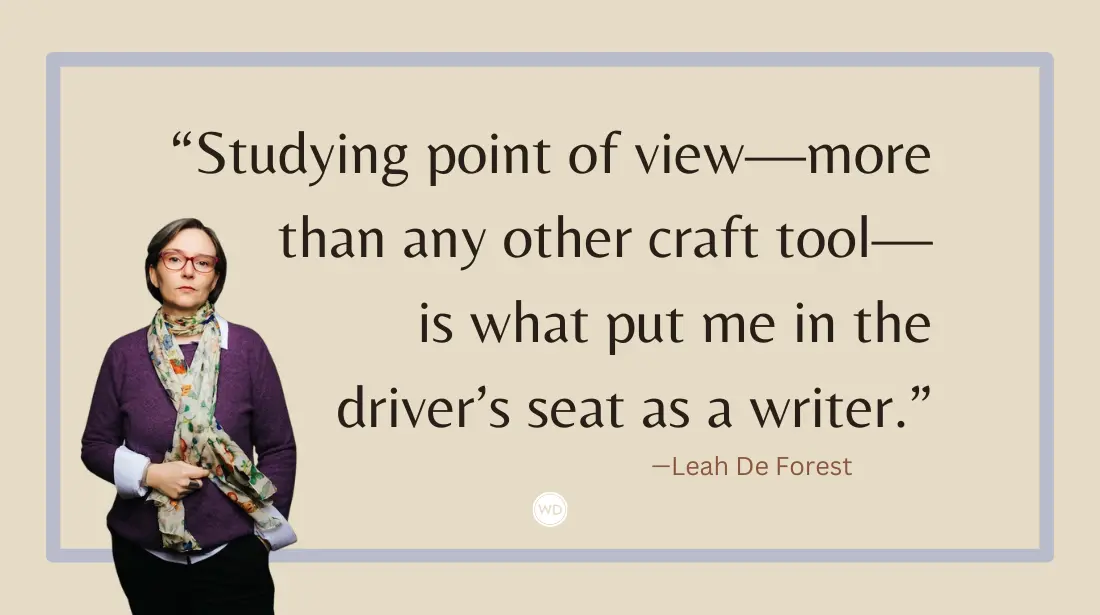
Stuck in the middle of a draft, the author faces a crossroads. Continuing to force square-peg scenes into round-hole perspectives leads to frustration. The turning point occurs when the writer stops treating POV as an immutable given and begins experimenting with structural alternatives. By systematically stress-testing the narrative through different lenses—shifting from first-person to third, introducing multiple focal characters, or deploying flexible omniscience—the writer transitions from a passive passenger to an active driver in control of their literary vehicle.
Supporting Context & Metrics: Four Crucial Scenarios for POV Intervention
When a writing project stalls, diagnosing the precise nature of the breakdown is half the battle. Strategic manipulation of point of view can resolve four of the most common narrative impasses.
1. When Your Project is Stuck (The Anatomy of "The Gloom")
When narrative momentum grinds to a halt, the temptation is to alter the setting or force a high-stakes plot twist. However, opening up a piece often requires a lateral shift in perspective.
- The Exercise: Take a stalled page or two and rewrite it across multiple perspectives.
- If it is currently in the first person, convert it to a single-focal-point third person.
- Expand it to a multi-POV ensemble cast.
- Test it in the second person (you) to force an uncomfortable intimacy.
- Experiment with first-person direct address to interrogate who the narrator is actually speaking to.
- The Execution: Writers who feel uncertain about unfamiliar POV techniques should treat their personal libraries as a laboratory. By locating masterworks that utilize these modes, reading them with an analytical eye, and working backward to deconstruct their mechanics, authors can decode how professional writers maintain narrative authority across diverse perspectives.
2. When the Story Feels Trapped in the Narrator’s Head
While first-person narration offers unmatched intimacy, it can inadvertently act as a prison. If a first-person narrator is physically isolated or intellectually limited, the writer is forced into heavy-handed exposition—relying on clunky newspaper clippings, convenient television broadcasts, or serendipitous phone calls to fill in the narrative blanks.
- The Solution: Broaden the optical field. Moving to serial third-person narrators allows the story to follow different characters into the literal and figurative streets, providing external perspectives on localized events (such as observing that controversial window-leap from the pavement below).
- Flexible Omniscience: For ultimate narrative freedom, writers can deploy a god-like omniscient narrator capable of fluidly gliding in and out of multiple minds. To master this intimidating technique, authors can adopt a color-coding methodology: take a published novel that excels at flexible omniscience (such as Bonnie Garmus’s Lessons in Chemistry), assign one color to the narrator’s overarching voice and distinct hues to each character’s internal landscape, and trace how the author executes seamless transitions.
3. When Characters Feel Remote (In a Bad Way)
A pervasive myth in creative writing circles is that third-person narration inherently lacks intimacy. In practice, the emotional temperature of a scene is dictated by the modulation of psychic distance—the invisible gap between the narrator’s objective voice and a character’s subjective mind and body.
- The Calibration: If readers report feeling detached from a story, the psychic distance is likely set too wide, observing the character from across a metaphorical ocean rather than riding alongside their deepest consciousness. Writers can remedy this by systematically identifying opportunities to deepen interiority, aligning the prose so closely with the character’s cognitive rhythms that readers are actively thinking alongside them.
- The Paradigm Shift: If adjusting psychic distance fails, the diagnosis may be more fundamental: the story simply demands the unmediated vulnerability of the first person. Discovering this halfway through a novel-length draft is not a failure; it is a vital diagnostic breakthrough that points toward the true home of the narrative.
4. When Your Narrator Lacks Perspective
When a first-person narrator feels flat, trapped entirely in the breathless immediacy of the present moment, the narrative loses its analytical depth.
- The Retroactive Lens: Introducing retrospection transforms the narrative voice. A narrator looking backward speaks with a dual consciousness: the naive past self who experienced the trauma or triumph, and the mature present self who possesses the wisdom to reflect upon it.
- The Motorcycle Sidecar: If retrospection does not fit the tone, authors can utilize a tight third-person perspective with minimal psychic distance. Dubbed "Motorcycle Sidecar" mode by critic Lincoln Michel, this technique keeps the narrator tracking closely behind the character—restricted primarily to what that individual knows and perceives, yet maintaining just enough separation to provide structural clarity.
Expert Insights & Perspectives
Literary critics and master craftsmen have long debated the psychological weight of narrative perspective. Industry veterans consistently emphasize that point of view is not merely a stylistic choice, but the foundational architecture upon which character credibility and thematic resonance are built.
"Point of view is the hinge upon which all fictional reality turns. If the hinge is rusted or misaligned, the heaviest plot mechanics will drag and ultimately collapse under their own weight."
When workshoppers object to a character’s passivity or question an irrational plot choice, they are often reacting to a fundamental mismatch between the character’s agency and the narrative lens assigned to them. A passive character rendered through a detached, analytical lens will feel lifeless; conversely, an erratic, high-velocity character viewed through an overly clinical third-person narrator will feel irrational and unmotivated.
By treating point of view as a dynamic instrument rather than a static default, authors gain the diagnostic tools necessary to diagnose these structural disconnects. As contemporary novelists and instructional texts demonstrate, experimentation with perspective transforms writing from a frustrating process of blind trial-and-error into a deliberate, masterclass exercise in artistic control.
Future Outlook: Navigating the Craft Landscape
As the literary landscape continues to evolve, the demand for sophisticated, structurally resilient storytelling remains paramount. Writers navigating the perennial trials of "The Gloom" are increasingly encouraged to step outside their technical comfort zones early in the developmental process.
The future of narrative craft education points toward a more modular, experimental approach to novel-writing—one where aspiring authors actively test multiple points of view during outlining and early drafting phases rather than locking themselves into a single perspective prematurely. By embracing the full spectrum of POV techniques—from intimate first-person retrospection to fluid, multi-focal omniscience—writers can future-proof their manuscripts against common structural pitfalls.
Ultimately, mastering point of view does more than just solve workshop critiques; it empowers creators to unlock the true psychological depths of their stories, ensuring that every narrative lens is precisely calibrated to bring their artistic vision into sharp, unforgettable focus.




Comments
Facebook App ID not configured. Please add it in the Customizer.