
Executive Overview
For centuries, the genesis of Paris has remained shrouded in a fog of historical ambiguity, classical myth, and fierce academic debate. While the grandeur of Roman Lutetia—and its subsequent evolution into the glittering capital of modern France—is well-documented through monumental architecture, statues, and vast networks of subterranean infrastructure, its pre-Roman origins have long eluded concrete proof. Generations of historians and archaeologists have debated the exact geographic footprint of the Parisii, the Celtic Gallic tribe that first settled the banks of the Seine. Did the city truly begin on the Île de la Cité, the historic heart of modern Paris, or was the original settlement located miles away in the surrounding Parisian basin?
That enduring historical riddle may finally have been solved.
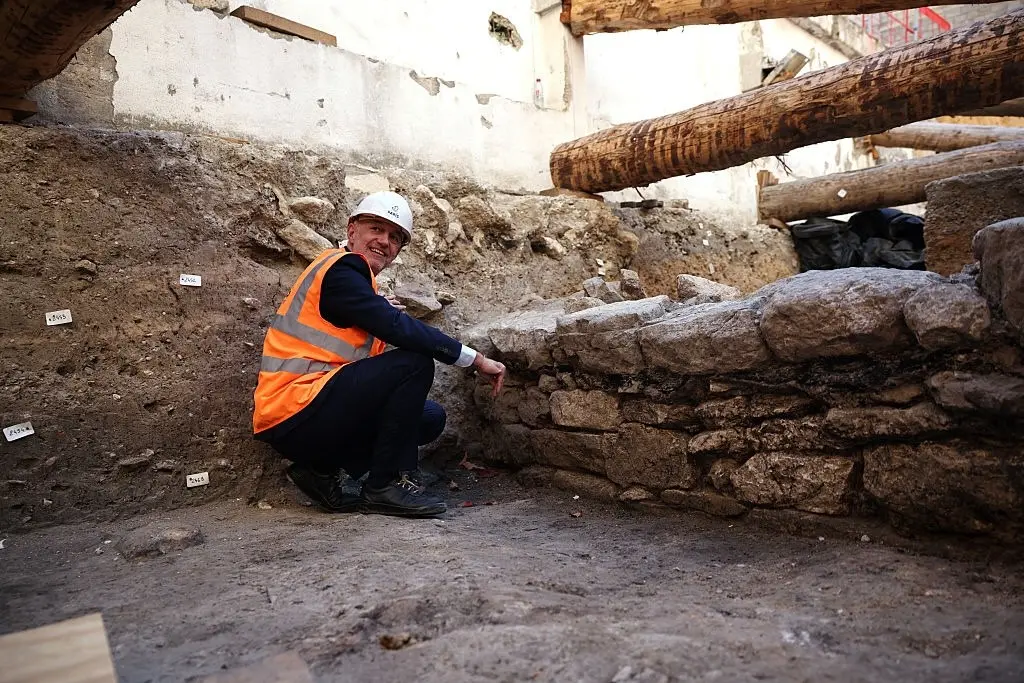
Beneath the historic Hôtel Dieu hospital on the Île de la Cité, a routine construction project has yielded an extraordinary archaeological discovery: a massive, 72-foot-long stone-and-wood defensive wall dating back to the twilight of the Gallic era. Unearthed alongside a ceremonial or functional Gallic spearhead, the rampart has been carbon-dated to between 200 BCE and 10 BCE. This temporal window places the structure squarely in the turbulent epoch of the Roman Republic’s conquest of Gaul, aligning dramatically with the geopolitical shifts that brought Julius Caesar’s legions to the banks of the Seine.
Read Also
The implications of this discovery are monumental. For decades, a faction of prominent scholars argued that the primary pre-Roman settlement of Lutetia must have been situated elsewhere, pointing to substantial archaeological finds in modern-day Nanterre, located west of central Paris. The Île de la Cité, they contended, lacked the physical footprint necessary to support a major Iron Age population center. However, the revelation of a sophisticated defensive fortification directly in the geographical core of the modern capital has instantly shifted the scholarly consensus. Leading skeptics have publicly capitulated, conceding that the historical accounts penned by Roman conquerors over two millennia ago were accurate all along.
Beyond settling a decades-long academic turf war, the discovery introduces a thrilling, cinematic possibility: physical evidence of the legendary destruction of Lutetia. The newly discovered wall bears unmistakable signs of severe fire damage, corroborated by the discovery of charred seeds and the remnants of burned wooden structures in the immediate vicinity. While French cultural authorities urge caution, noting that rigorous analytical work remains to be completed, the prospect that archaeologists have touched the ashes of a city burned by its own inhabitants to thwart Roman invaders has captured the global imagination. This comprehensive report explores the discovery, its historical context, the shifting archaeological paradigms, and what the future holds for the nascent roots of the City of Light.
Detailed Chronology: From the Parisii to the Roman Conquest
To understand the magnitude of the Hôtel Dieu discovery, one must journey back to the turbulent final centuries of the first millennium BCE. Long before the spires of Notre-Dame pierced the Parisian sky or the boulevards of Haussmann carved up the cityscape, the region was inhabited by the Parisii, a seafaring and trading Celtic tribe of the Belgic or broader Gallic confederation. Preferring the strategic advantages of the Seine River basin, the Parisii established a fortified fishing and trading post on the Île de la Cité—a natural island offering inherent defensive perimeters against rival tribes and external aggressors.
The earliest written documentation of this nascent settlement comes down to us through the lens of Roman imperialism. In his military memoirs, Commentarii de Bello Gallico (Commentaries on the Gallic War), Julius Caesar chronicled his relentless campaigns to subjugate the Gallic tribes between 58 and 50 BCE. Within these texts, Caesar refers to a settlement named Lutetia (often Latinized as Lutetia Parisiorum), describing it as a fortified oppidum—a fortified Iron Age settlement—situated upon an island in the middle of the river Sequana (the Seine).
According to Caesar’s strategic accounts, Lutetia occupied a critical chokepoint in the region’s economic and logistical networks. However, as the might of the Roman legions drew closer to the heartland of the Parisii in 52 BCE, the inhabitants chose destruction over subjugation. In a desperate bid to deny the invading Roman general Titus Labienus—one of Caesar’s most trusted lieutenants—a strategic foothold, the indigenous defenders made a fateful decision. Historical accounts dictate that the Parisii burned their own settlement to the ground and systematically demolished the wooden bridges connecting the island to the northern and southern banks of the Seine.
Despite these scorched-earth tactics, Roman military superiority prevailed. Labienus and his legions outmaneuvered the defenders, crossing the river and seizing control of the island. Thus began the Romanization of Lutetia. Under imperial rule, the modest Gallic settlement was rapidly transformed into a classic Gallo-Roman town. The conquerors laid out a traditional grid system, constructed stone villas, erected aqueducts, and built monumental civic structures, including public baths, a grand amphitheater (the Arènes de Lutèce), and a forum on the slopes of the Sainte-Geneviève hill on the Left Bank.
Yet, while the Roman footprint (Lutetia Parisiorum) became abundantly clear through centuries of subsequent urban development and archaeological excavation, the physical traces of the pre-Roman Celtic settlement remained frustratingly sparse. For generations, historians were forced to rely almost entirely on Caesar’s brief, politically motivated dispatches, leaving a yawning chasm in the foundational narrative of Paris.
Supporting Context & Metrics: The Great Lutetian Debate
For the better part of the late 20th century, a fierce debate raged within the European archaeological community regarding the true location and scale of pre-Roman Lutetia. While traditionalists clung to the literal interpretation of Caesar’s writings—insisting that the modern Île de la Cité was the cradle of the city—a growing contingent of contemporary archaeologists began to voice profound skepticism.
This skepticism was not born of contrarianism, but of hard empirical absence. Despite centuries of digging, construction, and infrastructural overhauls on the Île de la Cité, excavations yielded very little material culture dating to the pre-Augustan Iron Age. There were no grand ramparts, no extensive domestic quarters, and precious few artifacts that could definitively point to a major indigenous urban center.
Instead, archaeological focus began to shift westward. During extensive excavations in the modern suburb of Nanterre throughout the 1980s and 1990s, researchers uncovered a sprawling, highly sophisticated Gallic complex. Nanterre yielded vast quantities of Iron Age artifacts, extensive settlement boundaries, coinage, ritual enclosures, and evidence of a dense population that clearly played a dominant economic role in the region.
This wealth of data led many respected scholars to formulate a revolutionary hypothesis: perhaps Caesar’s "Lutetia" was a flexible geographic term, or perhaps the primary administrative and population center of the Parisii was actually located in Nanterre, while the Île de la Cité was little more than a minor marshland outpost or temporary fortification used only in times of crisis. By the turn of the 21st century, this "Nanterre-centric" view had gained significant academic currency, casting doubt on the traditionalist narrative that Paris was inherently and uninterruptedly born on the island in the Seine.
The Metrics of the Discovery
The newly discovered wall at the Hôtel Dieu hospital shatters this alternative consensus through sheer physical data. The metrics and attributes of the find include:
- Length: A continuous 72-foot stone-and-wood defensive structure.
- Composition: An advanced composite construction utilizing both quarried stone blocks and heavy timber reinforcement—typical of high-status Gallic fortifications (known as murus gallicus techniques).
- Chronological Dating: Carbon-14 (radiocarbon) dating places the construction and active phase of the wall between 200 BCE and 10 BCE.
- Accompanying Artifacts: A well-preserved Gallic spearhead discovered directly within the stratigraphic context of the wall.
- Destruction Evidence: Charred agricultural seeds, ash layers, and the structural remains of a burned wooden building immediately adjacent to the rampart.
Official Statements and Scholarly Reactions
The revelation of the Hôtel Dieu wall has sent shockwaves through the academic community, prompting rapid reassessments by scholars who had previously dismissed the primacy of the Île de la Cité.
Chief among them is Matthieu Poux, a distinguished professor of archaeology at the University of Lyon II. Prior to the summer excavation, Professor Poux was one of the most vocal proponents of the theory that ancient Lutetia’s true heart lay outside the central island, championing the significance of the Nanterre discoveries. However, confronted with the empirical data recovered from the hospital basement, Poux’s skepticism evaporated.
In an interview with the New York Times, Poux stated unequivocally that the find had completely altered his perspective. He now harbors "no doubt" that the ancient Celtic city was indeed anchored on the Île de la Cité, recognizing that the physical evidence finally matches the historical texts. Poux further emphasized the sheer scarcity of pre-Roman material from central Paris prior to this event, noting that this single excavation has effectively increased the available physical evidence regarding Gallic Paris "tenfold."
Meanwhile, representatives from the French Ministry of Culture have adopted a measured, rigorously scientific approach to the discovery. While acknowledging the immense historical weight of the find, cultural officials have stressed that comprehensive laboratory analysis is still required. The Ministry noted that further interdisciplinary research—including dendrochronology (tree-ring dating) of the timber elements and advanced micro-stratigraphic analysis of the soil layers—is necessary to establish the precise construction sequence and the exact functional purpose of the wall.
Crucially, researchers are exercising extreme caution before formally linking the burned layers of the wall to the specific events of 52 BCE described by Julius Caesar. While the chronological window (200 BCE to 10 BCE) certainly encompasses the Gallic Wars, and the presence of fire damage is undeniable, historical science demands absolute proof before connecting a specific archaeological stratum to a single, textually recorded event. Nevertheless, the physical alignment between the historical narrative and the archaeological data is closer than it has ever been in the history of Parisian scholarship.
Future Outlook: Preservation, Exhibition, and Ongoing Excavations
As the initial excitement surrounding the Hôtel Dieu discovery settles into methodical scientific inquiry, the operational focus of the French archaeological teams has shifted toward preservation and future excavation phases.
The Île de la Cité is one of the most densely layered urban archaeological sites in the world. Every square foot of soil holds centuries of overlapping history, ranging from medieval foundations and Renaissance cellars down to Roman administrative centers and now, finally, the elusive Iron Age strata of the Parisii. Because the newly discovered wall was uncovered during ongoing, necessary construction work at the historic Hôtel Dieu hospital, urban planners and heritage conservationists face a delicate logistical challenge: how to balance modern infrastructure needs with the preservation of a priceless historical artifact.
Current plans dictate that comprehensive, non-destructive mapping and high-resolution 3D laser scanning of the wall will be completed in situ. Following this documentation phase, the 72-foot stone-and-wood structure will be carefully dismantled, extracted, and transported to specialized conservation laboratories. There, conservators will stabilize the waterlogged and charred timbers, treat the stone masonry, and conduct ongoing chemical and biological analyses.
Furthermore, additional archaeological excavations have been scheduled in the immediate vicinity of the hospital complex. Archaeologists hope that expanding the footprint of the dig will unearth additional domestic structures, defensive outworks, or refuse pits that can shed light on the daily lives, trade networks, and social stratification of the Parisii tribe before the heavy hand of Roman urbanization wiped away their culture.
Ultimately, cultural authorities and city officials intend to display the wall to the public. While discussions regarding the final exhibition venue are ongoing, proposals include integrating the ancient rampart into a permanent or semi-permanent museum installation within Paris, allowing both citizens and international visitors to gaze upon the literal foundation stones of the French capital.
In the end, the wall beneath the Hôtel Dieu hospital does more than simply close a long-standing academic debate. It bridges the gap between myth and reality, offering a tangible, visceral connection to the people who first looked out over the winding waters of the Seine, lit the fires of resistance, and inadvertently laid the first stones of a city that would one day conquer the world’s cultural imagination.





Comments
Facebook App ID not configured. Please add it in the Customizer.