The children’s publishing landscape is on the cusp of a profound literary event with the upcoming release of Postcards from Malcolm X: How Yuri Kochiyama Became a Human Rights Activist. Authored by Mia Wenjen and meticulously brought to visual life by award-winning illustrator Keith Henry Brown, the picture book biography explores one of the twentieth century’s most unique, transformative, and historically significant cross-racial alliances. Scheduled for publication by Abrams on October 13, 2026, the volume charts the 16-month relationship between legendary civil rights leader Malcolm X and Japanese American activist Yuri Kochiyama.
In an exclusive retrospective and forward-looking interview, illustrator Keith Henry Brown opens up about the multi-year journey required to bring this historical text to the page. Ranging from his roots in comic art and jazz album design to his deep personal connections with historic community preservation, Brown illuminates the delicate synthesis of historical research, watercolor execution, and political empathy that defines his aesthetic. This executive profile examines the genesis of Postcards from Malcolm X, investigates the intersectional themes binding Black and Asian American history, and contextualizes Brown’s broader career trajectory within contemporary children’s literature.
Detailed Chronology: The Evolution of Keith Henry Brown
From Comic Books to the Canvas
Keith Henry Brown’s path to becoming one of children’s literature’s most sought-after visual chroniclers was unconventional. Breaking into the industry immediately after high school as a comic book artist, Brown quickly realized that the commercial landscape required versatility. He pivoted into graphic design and art direction, establishing a formidable reputation as a commercial illustrator.
However, the definitive turning point in his career arrived through his extensive work in the music industry. While designing jazz album covers for Christian McBride—the 11-time Grammy Award-winning bassist and composer—Brown caught the attention of mainstream publishing houses. A publisher approached him with a proposition: could he adapt his sophisticated, rhythmic design aesthetic to a full-length children’s book?
That project became Birth of the Cool: How Miles Davis Found His Sound, written by Kathleen Cornell Berman. The book garnered immediate critical acclaim, including a coveted starred review from Kirkus Reviews. The success of Birth of the Cool signaled a paradigm shift in Brown’s professional trajectory, transforming him from a commercial graphic designer into a premier biographical illustrator for young readers.
The Three-Year Wait for Postcards from Malcolm X
Such is Brown’s standing in the literary community that publishers routinely wait years to secure his artistic signature. Editorial teams spent three years waiting for Brown’s schedule to clear before he could formally accept the commission for Postcards from Malcolm X.
Rather than a reflection of casual delay, this scheduling window was necessitated by Brown’s intense dedication to monumental projects. During this period, he was completing Pushing Hope: An Illustrated Memoir of Survival, a sprawling 200-plus-page graphic novel co-authored by Raymond Santana. Recognizing the profound historical weight of Yuri Kochiyama and Malcolm X’s partnership, Brown insisted on reserving the intellectual and temporal space necessary to render the manuscript with absolute authenticity.
Supporting Context & Metrics: The Historical Foundation of an Alliance
To fully appreciate Brown’s visual interpretation in Postcards from Malcolm X, one must understand the historical landscape of the subjects. Yuri Kochiyama was already a seasoned community organizer and civil rights activist when she met Malcolm X in the early 1960s. Having survived the systemic trauma of the World War II Japanese American internment camps, Kochiyama possessed an innate drive to mobilize communities against institutional oppression.
Yet, it was her interaction with Malcolm X that catalyzed her evolution from a domestic civil rights worker into a global human rights advocate. Malcolm served as a mentor and teacher, parsing complex structural frameworks of power, imperialism, and human dignity in accessible terms. Though their personal mentorship lasted a mere 16 months before Malcolm X’s tragic assassination in 1965, the bond endured. The primary historical artifacts of this relationship—11 postcards sent by Malcolm X during his historic second trip abroad—serve as physical testaments to an intellectual and political awakening.
Personal Resonance and the Basement Workshop Connection
For Brown, illustrating this text was not merely an assignment; it was a deeply personal journey rooted in familial history. Growing up, Brown witnessed the burgeoning Asian American movement firsthand. His brother was actively involved with the Basement Workshop during the 1970s—the pioneering Asian American arts and political organization founded in New York City’s Chinatown in 1969.
[Historical Anchor: 1969]
       │
       ├──> Basement Workshop (Chinatown, NYC) ──> Formative influence on Keith Henry Brown's youth
       │
[Mentorship: 1963-1965]
       │
       ├──> Malcolm X & Yuri Kochiyama ────────> 16-month alliance shaping global human rights activism
       │
[Literary Release: Oct 13, 2026]
       │
       └──> Postcards from Malcolm X ──────────> Published by Abrams, illustrated by Keith Henry Brown
This early immersion in cross-cultural solidarity left an indelible impression on the artist. Witnessing how Asian American artists and Black liberation movements found common purpose in post-civil rights urban centers informed every brushstroke Brown applied to the pages of Postcards from Malcolm X.
Official Statements & Insights: A Conversation with Keith Henry Brown
In a series of reflections on the creation of his latest masterpiece, Brown shares intimate details of his research trips, artistic breakthroughs, and creative philosophy.
On Artistic Vision and Favorite Spreads
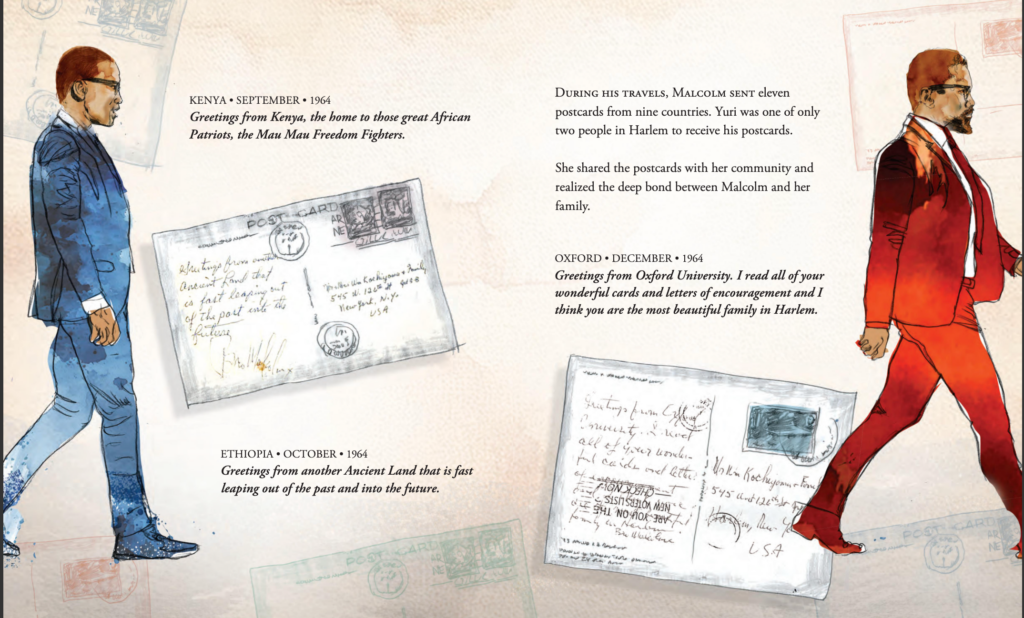
Discussing his favorite visual compositions within the book, Brown points directly to a symbolic, time-bending spread featuring Malcolm X:
"One of my favorite spreads is the one where Malcolm appears to be walking across time. On the left, he’s younger, clean-shaven, and wearing a blue suit. On the right, he’s older, bearded, and dressed in red, as if he’s been walking and evolving over the years. Surrounding him are reproductions of the actual postcards."
For an artist known for his rigorous self-criticism, this particular layout represents a rare moment where execution met imagination. "I’m a very self-critical artist, and I rarely feel I’ve fully achieved what I see in my imagination, but that illustration came closer than most. The watercolor effects worked the way I hoped, and the symbolism feels strong."
On On-Site Research and Easter Eggs
Authenticity was a driving force behind the artwork. To capture the environment that shaped Kochiyama and Malcolm X’s interactions, Brown physically visited the locations referenced in the text.
"I actually visited the location while researching the book. I had imagined it would be a classic Harlem brownstone, but it turned out to be part of a housing project. I found it moving that she chose to live there and build authentic relationships with her neighbors and the surrounding community."
This commitment to lived accuracy functions as the book’s primary "Easter egg." The architectural backdrops, streetscapes, and community spaces depicted across the spreads are grounded in the physical reality Brown encountered during his field research in Harlem and New York City.
Future Outlook: Beyond Postcards from Malcolm X
Even as the literary world prepares for the October 13, 2026 release of Postcards from Malcolm X, Keith Henry Brown shows no signs of slowing his creative output. His next major undertaking shifts focus to another overlooked chapter of American labor and civil rights history: Pullman Porters Deliver, written by Lea Lyon and published by Abrams.
Pullman Porters Deliver
The upcoming book chronicles the arduous struggle of the Pullman porters to organize the first major Black labor union. Much like his connection to the Basement Workshop, this project carries deeply personal significance for Brown.
"I actually had a relative who was a Pullman porter, so the project has a personal connection for me. It’s a fascinating and important part of American history that many people don’t know about. Even while researching the book, I found myself learning things I’d never heard before. It’s a beautifully written manuscript, and I’m excited to help bring this story to life with Abrams."
Conclusion: A Blueprint for Intersectional Unity
As contemporary society navigates increasingly polarized political and cultural landscapes, the collaborative work of Mia Wenjen and Keith Henry Brown offers a timely navigational tool. Postcards from Malcolm X is more than a historical biography for readers ages 7 and up; it is an illustrated manifesto on the power of coalition-building.
As Brown aptly summarizes:
"More than anything, I hope readers come away with a sense that people from different backgrounds can find common purpose. I’ve always believed that people of different races and cultures can be friends, collaborators, and family. At a time when it sometimes feels like we’re pulling apart, I hope this story reminds readers of what’s possible when we come together."
With pre-orders currently open ahead of its October 2026 launch, Postcards from Malcolm X stands poised to inspire a new generation of readers to look across historical, racial, and cultural divides in pursuit of a more equitable world.















Comments
Facebook App ID not configured. Please add it in the Customizer.