

Executive Overview
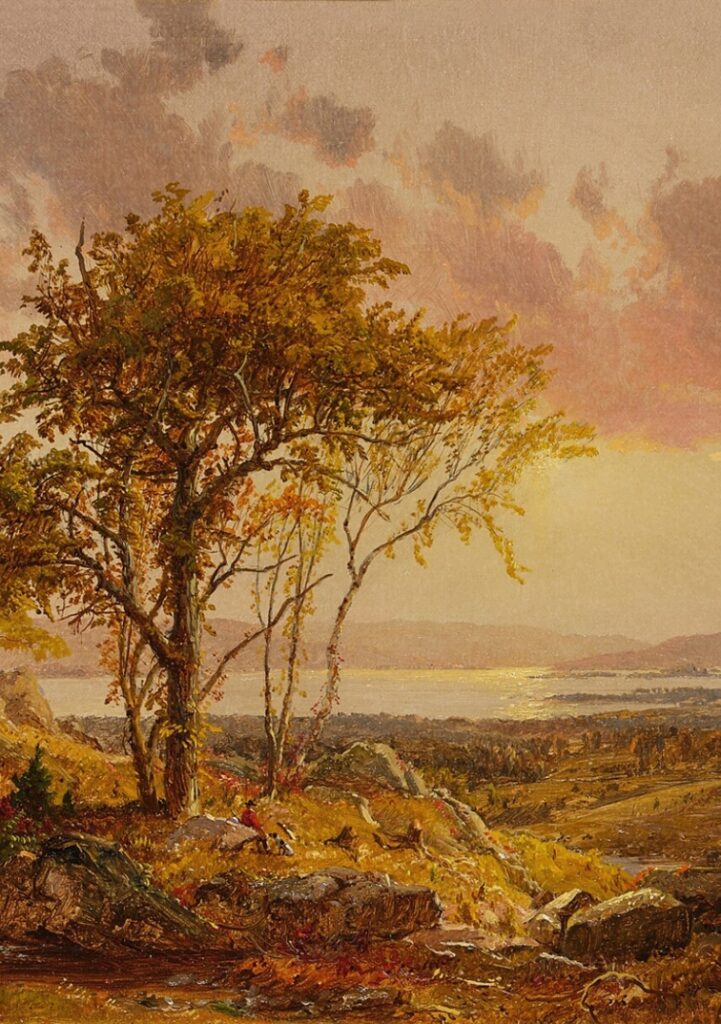
In the contemporary landscape of American poetry, few voices manage to balance devastating emotional candor with the dry, observational wit of everyday absurdity quite like Bob Hicok. On October 26, 2026, The Missouri Review designated Hicok’s poem, “Observations meant to enlighten can also obscure,” as its prestigious Poem of the Week. Accompanied visually by Jasper Francis Cropsey’s 1873 Hudson River School masterpiece, A Distant View of the Hudson River in the Fall, the selection places Hicok’s gritty, contemporary vernacular into direct dialogue with 19th-century American romanticism.
The poem itself is a masterclass in tonal juxtaposition, weaving together surreal imagery—such as sharks acting as oceanic vacuum cleaners pulling wallets and astrolabes from the deep—with profound human vulnerability. It touches upon the profound weight of mental health struggles, the quiet indignities of modern alienation, and the desperate search for meaning in a universe that often replies with silence. As Hicok’s latest collection, Breathe, published by Copper Canyon Press earlier this year, continues to garner critical acclaim, this weekly spotlight offers a timely examination of one of the most distinctive poets writing today. This review explores the structural brilliance, thematic resonance, and cultural placement of a poem that asks readers to reconsider the very nature of wisdom, observation, and existence.
Detailed Chronology and Literary Context
The journey of Bob Hicok’s poetry to this recent recognition is rooted in a decades-long career defined by accessibility, linguistic surprise, and a steadfast refusal to romanticize the human condition. Over the years, Hicok has built a reputation for poems that begin in casual, conversational territory—often sounding like an eccentric friend talking across a kitchen table—before pivoting sharply into existential philosophy.
Read Also
- Early 2026: Bob Hicok releases his latest full-length poetry collection, Breathe, through Copper Canyon Press, cementing his status as a vital force in contemporary American verse and drawing praise for his unflinching look at mortality, technology, and grief.
- Fall 2026: As part of its ongoing editorial curation, The Missouri Review selects individual works to highlight the breadth of modern poetry, choosing Hicok’s piece for its distinct psychological depth.
- October 26, 2026: “Observations meant to enlighten can also obscure” is officially named Poem of the Week by The Missouri Review, accompanied by Jasper Francis Cropsey’s historic painting A Distant View of the Hudson River in the Fall (1873). The pairing juxtaposes the luminous, autumnal splendor of 19th-century landscape art with Hicok’s gritty, urban-and-suburban realism.
- Present: The poem circulates widely among literary circles, sparking discussions regarding its raw depiction of crisis intervention, mental health, and the therapeutic nature of mundane labor.
Supporting Context & Metrics: Deconstructing the Text
To understand why “Observations meant to enlighten can also obscure” resonates so deeply with critics and readers alike, one must examine its intricate architecture and thematic motifs.
The Surreal and the Mundane
The poem opens with a disarming blend of nature writing and black comedy:
No one had to teach moonlight
how to whisper. And sharks
are natural vacuum cleaners.
They found a wallet, license plate,
astrolabe, and loneliness
in one I saw cut open
in Santa Monica.
Hicok establishes an immediate tonal baseline where the sublime (moonlight) rubs shoulders with the bizarre (sharks functioning as domestic appliances of the deep). The discovery of "loneliness" inside a dissected shark in Santa Monica is a brilliant poetic sleight-of-hand. It externalizes an internal state, projecting human isolation into the belly of a marine predator alongside mundane lost artifacts like a wallet and an astrolabe—an instrument used for navigating the stars, now rendered useless in the dark belly of the sea.
The Weight of Crisis and the Search for Honesty
The emotional core of the poem shifts dramatically when Hicok addresses his brief, harrowing stint on a suicide hotline:
I lasted half a day on the suicide hotline.
Wasn’t cut out to tell the woman
who cried the whole time, whose cancer
had Alzheimer’s, who was broke
and alone and afraid of the dark,
that she had so much to live for.
I wanted to be honest and tell her
she had so much to die for…
This stanza has drawn significant commentary from literary analysts for its raw, unflinching confrontation with institutionalized optimism. Rather than offering platitudes, the speaker recognizes the inadequacy of standard clinical encouragement when confronted with compounding tragedies—cancer, cognitive decline, poverty, and existential fear. The pivot from "so much to live for" to "so much to die for" is not necessarily a celebration of death, but an expression of radical, painful honesty. It honors the caller’s suffering rather than attempting to minimize it with cheerful toxic positivity.
Labor, Philosophy, and Silence
Following his departure from the hotline, the speaker takes a job raking leaves for the city, anchoring the narrative in physical, repetitive work. Hicok invokes the pre-Socratic philosopher Heraclitus with characteristic dry wit: "you never rake the same leaves twice." The sound of the leaves becomes a substitute for human community—"kind of like the murmur in a bar, / so I never feel alone."
The poem concludes with a haunting meditation on perception and the void:
A psychiatrist
once asked me if a glass
was half full or half empty.
This was after I was released
from the restraints.
Without thinking, I said the glass
is thirsty and so am I.
By subverting the tired glass-half-full dichotomy, Hicok reframes the existential dilemma not as a matter of perspective, but of shared, universal need. The final lines drift into a quiet, nocturnal cadence:
Moonlight whispers as if afraid
of waking the baby up.
When I close my eyes and press my ear
to the sky, I hear nothing,
which is the mother of nothingness,
calling me home.
Official Statements and Critical Reception
While individual poets rarely issue press releases for weekly publication honors, the cultural weight of The Missouri Review’s curation reflects a broader critical consensus surrounding Hicok’s trajectory. Reviewers of his 2026 collection Breathe have frequently noted his unique ability to locate grace within trauma and humor within despair.
Literary critics have long praised Hicok for his democratic poetic style—one that avoids academic gatekeeping in favor of emotional resonance. By utilizing everyday diction, pop-culture touchstones (like imagining Saint Monica sharing popcorn at a movie theater), and stark philosophical inquiries, Hicok bridges the gap between high literary art and lived human experience.
The pairing with Jasper Francis Cropsey’s 1873 painting A Distant View of the Hudson River in the Fall further enhances the official presentation by the journal. Cropsey, known for his luminous depictions of American autumnal landscapes, provides a visual counterweight to Hicok’s urban and psychological terrain. Where Cropsey captures the grand, sweeping melancholy of a changing season, Hicok captures the microscopic, jagged edges of an individual mind navigating its own internal weather.
Future Outlook: The Enduring Legacy of Bob Hicok’s Voice
As "Observations meant to enlighten can also obscure" circulates among new readers and longtime admirers alike, it serves as a signpost for where contemporary American poetry is heading. In an era dominated by rapid digital communication and often superficial emotional displays, Hicok’s work demands slowness, attention, and a willingness to sit with discomfort.
The recognition by The Missouri Review underscores the enduring relevance of poetry that refuses to look away from mental health struggles, aging, and the quiet griefs of daily life. With Breathe continuing to find its place on nightstands and in university syllabi throughout late 2026, Bob Hicok remains an indispensable chronicler of the modern psyche. His poems remind us that while observations meant to enlighten may occasionally obscure the path ahead, the act of looking—and of listening to the quiet murmur of the world—is itself a reason to keep going.





Comments
Facebook App ID not configured. Please add it in the Customizer.