
Executive Overview
Every writer is intimately familiar with the acute paralysis of the blank page. The ritual of sitting down to work is often accompanied by an internal tribunal of self-doubt: Is this plot structure viable? Is this prose overly clunky? Am I genuinely equipped for this vocation? When these anxieties cascade, the act of writing ceases to be a creative endeavor and transforms into a grueling, uphill slog.
However, an alternative psychological and neurobiological state exists. The most creatively productive days for any author are almost universally characterized by what psychologists term a "flow state"—a profound sense of total immersion where the hyper-critical inner voice evaporates, the perception of linear time warps, and the text appears to author itself. Hours evaporate in what feels like mere minutes. The physical grip on the pen or keyboard relaxes, and the writer steps out of their own way, acting merely as a conduit for the narrative or argument that demands expression.
Far from being an elusive mystical phenomenon or a rare stroke of artistic luck, flow is a hardwired neurobiological process. Dr. Susan J. Foster, an author and psychologist, experienced this firsthand while penning her book Righteous Rage: Why Feminism Needs the Fierce Goddesses. By examining the intersection of cognitive psychology and neuroscience, writers can demystify this "magic" and deliberately engineer their writing practices to trigger optimal performance on demand.
Read Also
Detailed Chronology: The Evolution of Flow in Creative Labor
To understand how contemporary writers can access the zone, it is helpful to trace how the relationship between human psychology, creative labor, and productivity has been studied over the past century.
1. Early 20th Century: The Discovery of Occupational Absorption
Long before the formal conceptualization of flow, early 20th-century psychologists recognized that intense concentration could alter human perception and output. Psychoanalytic thinkers observed that certain creators entered trance-like states during periods of intense inspiration, though these observations were largely anecdotal and lacked rigorous empirical backing.
2. 1975: Mihaly Csikszentmihalyi and the Formal Definition of "Flow"
The modern scientific understanding of the phenomenon began in the 1970s when pioneering psychologist Mihaly Csikszentmihalyi embarked on a comprehensive study of optimal experience. Interviewing chess players, rock climbers, composers, and artists, Csikszentmihalyi sought to understand why people dedicated themselves to rigorous activities that offered little to no external reward.
His subjects described a unified mental state characterized by effortless concentration, complete control, a loss of self-consciousness, and a distortion of temporal awareness. He formally named this phenomenon "flow"—derived from the spontaneous descriptions given by subjects who felt carried along by an effortless current.
3. The Turn of the 21st Century: Neuroimaging and the Brain in the Zone
As neuroimaging technology advanced in the late 1990s and early 2000s, cognitive neuroscientists began peering inside the working brains of individuals performing complex, creative tasks. Researchers discovered that flow is not merely a metaphor for high focus, but a distinct neurochemical and neurological shift.
The brain temporarily deactivates regions responsible for self-monitoring and temporal judgment—a phenomenon known in neuroscience as "transient hypofrontality." This structural dampening of the pre-frontal cortex silences the inner critic, allowing raw, uninhibited creative synthesis to take center stage.
4. Contemporary Application: Engineering Creative Productivity
Today, writers, corporate innovators, and high-performance coaches actively study flow theory to optimize workflows. By consciously manipulating environmental, psychological, and temporal variables, modern authors no longer wait for the muse to strike; instead, they construct deliberate systems designed to usher the brain into the neurobiological sweet spot of peak performance.
Supporting Context & Metrics: The Mechanics of the Creative Brain
To consistently trigger flow, a writer must first understand the precise neurological conditions required to sustain it. Flow occupies a narrow neurological sweet spot: the exact intersection where a writer’s skill level matches a high level of challenge.
- The Balance of Challenge and Skill: If a writing task is too rudimentary, the brain registers boredom, leading to wandering attention and frustration. Conversely, if the task is overwhelmingly difficult—such as attempting to draft a complex, multi-layered narrative arc without an outline—the brain spirals into anxiety, triggering a defensive stress response. Flow sits precisely between these two states, generating deep feelings of competence, mastery, and intrinsic satisfaction.
Neurological Shifts During Flow
When a writer successfully enters the zone, several remarkable physiological and neurological adjustments occur:
- Deactivation of the Default Mode Network (DMN): The DMN is the brain network responsible for self-referential thought, rumination, and worrying about the future or past. During flow, the DMN quiets down, effectively switching off the internal critic that whispers doubts about prose quality or market viability.
- Activation of the Task-Positive Network (TPN): While the DMN sleeps, the TPN surges into activity. This network manages external focus, problem-solving, and execution, allowing the writer to dive deep into the mechanics of storytelling or argument construction.
- A Neurochemical Cocktail: The brain releases a potent mix of performance-enhancing neurochemicals, including dopamine (which drives motivation, pattern recognition, and focus), norepinephrine (which heightens arousal and attention), endorphins (which reduce physical pain and fatigue during long writing sessions), and serotonin (which stabilizes mood and creates a sense of deep satisfaction).
This chemical high establishes a powerful intrinsic reward system. It fundamentally transforms writing from a grueling chore into a deeply pleasurable, nearly euphoric experience, reinforcing the psychological feedback loop that compels the writer to return to the page day after day.
Official Insights & Author Perspectives: Channeling the Collective Unconscious
The experience of flow often transcends clinical descriptions, touching upon deeply personal and artistic revelations. Reflecting on her own creative process during the composition of Righteous Rage: Why Feminism Needs the Fierce Goddesses, Dr. Susan J. Foster noted the profound sense of connection that accompanies deep creative immersion.
"The fierce goddesses of ancient times felt as though they were calling to me across the ages, as in a dream, communicating an urgent message for me to share about connecting with sacred rage to fight injustice," Foster explains. "Seeing myself as their vehicle, I let the message flow through me and channel cleanly onto the page."
This perspective highlights a core paradox of the flow state: by completely losing yourself in the process, you find an unmistakable sense of gladness bordering on ecstasy. The ego steps aside, and the work assumes a life of its own.
Four Practical Strategies to Prime Your Brain for Creative Flow
Recognizing that this "magic" is rooted in neurobiology rather than mystical luck empowers writers to construct deliberate frameworks for productivity. Here are four evidence-based strategies to prime the brain for creative flow:
1. Protect Your Time and Space
Because the brain requires a substantial buffer period to transition from the threat-seeking Default Mode Network to the focused Task-Positive Network, flow cannot be rushed. Squeezing a writing session into a hectic 30-minute window between domestic errands or professional obligations rarely succeeds.
- Actionable Step: Carve out protracted blocks of time—ideally a half-day, a full day, or a dedicated multi-hour window free from competing demands. Pair this time with a curated, comfortable workspace. Whether your view encompasses peaceful mountain ranges or a minimalist blank wall, your brain must learn to recognize this physical space as an inviolable sanctuary for creation.
2. Aggressively Eliminate Micro-Distractions
Every chime of an incoming smartphone notification or casual glance at an open browser tab forces the brain to reset, abruptly dragging it out of the Task Positive Network. Dopamine can only effectively filter out cognitive noise if you stop inviting distractions into your environment.
- Actionable Step: When it is time to write, turn off your mobile devices or place them in an entirely separate room. Close out email clients and social media applications. Guard your sensory environment fiercely; while some creators thrive with ambient instrumental music, others require absolute silence. Experiment to discover your personal threshold of focus, and defend it without apology.
3. Separate Creation From Editing
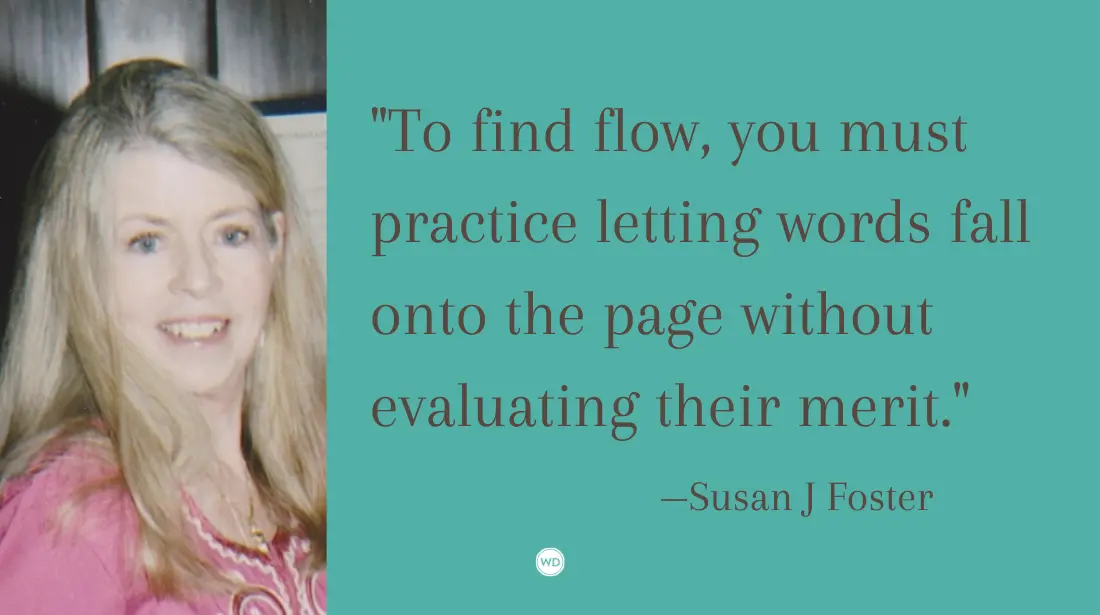
Perfectionism is the ultimate flow-killer because it forces the self-critical pre-frontal cortex to remain hyper-active throughout the drafting process. To access flow, a writer must practice relinquishing immediate judgment, allowing raw words to fall onto the page without evaluating their literary merit.
- Actionable Step: Adopt a strict, uncompromising "no editing while writing" rule. Your sole objective during a flow session is to produce a messy, unpolished draft that can be refined at a later date. Granting yourself permission to write poorly frees your cognitive architecture to write fluidly.
4. Set Micro-Goals to Balance the Challenge
Because flow requires a delicate equilibrium between perceived challenge and actual skill, an overwhelming macro-goal—such as declaring, "I am going to write a literary masterpiece chapter today"—instantly triggers performance anxiety and locks you out of the zone.
- Actionable Step: Lower the barrier to entry by establishing accessible micro-goals, such as committing to write a single page or 250 words per session. A manageable target reduces the psychological threat of failure, allowing your mind to quiet down, find its natural cadence, and let the act of writing take over.
Future Outlook: The Modern Writer’s Relationship with Deep Work
As the modern digital landscape grows increasingly saturated with algorithmic distractions, hyper-connectivity, and demands for rapid content production, the ability to enter a flow state is shifting from a luxury skill to a vital survival mechanism for creative professionals.
The future of authorship will likely belong not to those who can type the fastest or market the most aggressively, but to those who master the discipline of cognitive stamina. By treating the writing session as a neurobiological laboratory—where time is guarded, distractions are neutralized, and self-judgment is suspended—writers can reclaim the profound joy inherent in their craft.
We frequently fixate on the external validation of the literary life: landing a prestigious agent, securing a major traditional publishing contract, or winning critical accolades. Yet, the true sustenance of a writing career lies entirely within the act of writing itself.
When you learn to harness flow, your output is naturally elevated because it is unburdened by fear. By stepping aside and allowing your neurobiology to do the heavy lifting, you transform an inherently difficult craft into one of the most exhilarating and deeply rewarding human experiences imaginable.
Interested in exploring the intersection of psychology, ancient archetypes, and empowerment? Check out Susan J. Foster’s Righteous Rage: Why Feminism Needs the Fierce Goddesses to dive deeper into the themes of creative passion and social justice.





Comments
Facebook App ID not configured. Please add it in the Customizer.