
Executive Overview
The intersection of haute horlogerie and contemporary art has long been a fertile ground for creative experimentation, but few collaborations possess the historical authenticity of the ongoing partnership between Piaget and the Andy Warhol Foundation for Visual Arts. During his lifetime, the undisputed king of Pop Art amassed an eclectic and impressive watch collection, notably including roughly half a dozen timepieces crafted by Piaget.
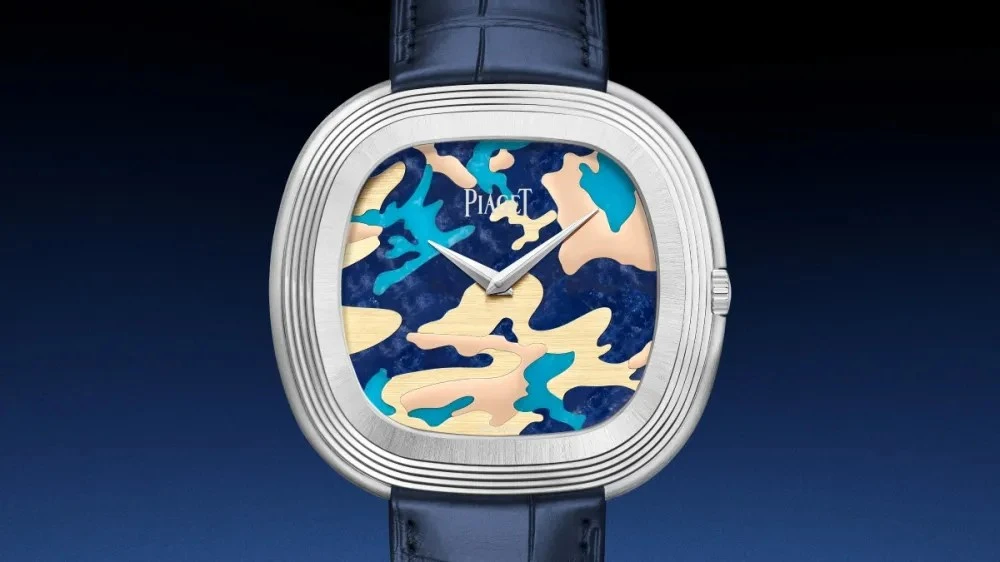
In a natural extension of this historical affinity, the storied Swiss watchmaker has once again joined forces with the foundation to immortalize Warhol’s visionary aesthetic on the wrist. Meet the Piaget Andy Warhol Camouflage watch—a masterwork of miniature marquetry and gem-setting directly inspired by Warhol’s iconic 1986 Camouflage self-portraits.
Strictly limited to just 86 pieces globally to honor the creation year of the source material, this timepiece transforms the bold, irreverent color palettes splashed across the artist’s face into a textural triumph of rare ornamental stones. Featuring a painstakingly constructed dial made of 27 individual pieces of sodalite and turquoise, paired with satin-finished and polished rose gold, the watch is driven by Piaget’s in-house 501P1 automatic caliber.
Read Also
This release marks the latest chapter in a formalized multi-year alliance that began in 2024 when Piaget officially rebranded its cushion-shaped "Black Tie" watch in Warhol’s honor. Following the vibrant Collage iteration, the Camouflage watch cements Piaget’s status as the definitive horological custodian of the Warhol legacy. As collectors and enthusiasts gather for events like Art Week NYC to explore the profound connections between Warhol’s personal collection and contemporary design, this latest release proves that the dialogue between pop culture and fine watchmaking is more vibrant than ever.
Detailed Chronology of a Horological Partnership
To fully appreciate the significance of the 86-piece Camouflage watch, one must examine the unfolding timeline of the partnership between the Swiss maison and the Andy Warhol Foundation for the Visual Arts. This relationship is not merely a transient marketing exercise; it is rooted in deep historical provenance, mutual admiration, and official licensing agreements that govern how the artist’s vast oeuvre is reinterpreted for the wrist.
The Foundation: Warhol and His Piaget Collection
Andy Warhol’s relationship with timepieces was complex. While he famously remarked that he didn’t wear a watch to tell the time—often stating, "I never wear a watch. I just wear a watch to know the time"—his personal collection told a different story. Warhol was a voracious collector of objects, ranging from cookie jars to fine art, and his accumulation of luxury wristwatches was substantial. Among his favorites were roughly seven timepieces crafted by Piaget. Known for their audacious, ultra-thin movements and unconventional, artistic case shapes, Piaget watches matched Warhol’s sensibilities, blending high-society elegance with avant-garde design.
2024: The Official Rebranding and the "Black Tie" Genesis
The modern collaboration officially commenced in 2024, when the Andy Warhol Foundation granted Piaget a groundbreaking authorization. The watchmaker was given the green light to officially rename its iconic "Black Tie" watch—itself a direct reinvention of the historic Ref. 15102, a 45mm cushion-shaped timepiece that once belonged to Warhol himself—in the artist’s honor.
Under the terms of this newly minted license, Piaget secured the right to craft one unique or strictly limited-edition watch annually, drawing direct inspiration from Warhol’s expansive multidisciplinary oeuvre. This set the stage for an annual ritual of artistic translation, where watchmakers and gem-setters would challenge the technical boundaries of miniature art.
2025: The Collage Precedent
Following the formal introduction of the partnership, Piaget dropped its inaugural creative exploration: the Collage timepiece in 2025. This model served as an immediate statement of intent. Rather than printing an image onto a standard dial, Piaget utilized stone marquetry to capture the spirit of Warhol’s graphic compositions. The dial featured precise blocks of rare pink opal, green chrysoprase, and yellow serpentine, establishing a blueprint for how the maison would utilize raw earth elements to mimic the punchy, saturated hues of Pop Art.
2026: The Arrival of the Camouflage Edition
Building upon the critical and commercial success of the Collage, Piaget unveiled the Andy Warhol Camouflage watch. Sourced directly from Warhol’s 1986 Camouflage self-portraits—a series where the artist masked his face behind a veil of abstract military camouflage patterns—the new timepiece pushes the craft of stone inlay to unprecedented heights. Commemorating the 1986 origin of the artwork, production is strictly restricted to 86 individually numbered pieces, ensuring immediate collectibility among blue-chip art collectors and horological connoisseurs alike.
Supporting Context, Craftsmanship, and Metrics
The creation of the Andy Warhol Camouflage watch is a tour de force of industrial design, gemological sourcing, and horological engineering. Translating the chaotic, high-contrast imagery of Warhol’s 1986 silkscreens into a functional, wearable dial required overcoming immense technical hurdles.
The Art of Stone Marquetry
The standout feature of the Camouflage watch is its mesmerizing dial. Eschewing traditional enamel or painted finishes, Piaget’s artisans turned to ornamental stonework to capture the undulating waves of blue and warm metallic tones seen in the original artwork.
- The Palette: Sodalite, with its deep, oceanic blue veins, is paired with vibrant turquoise to construct the aquatic foundations of the camouflage motif.
- Textural Contrast: These cool-toned stones are interwoven with sections of satin-finished and polished rose gold, creating a dynamic interplay of light, shadow, and tactile depth.
- Complexity: In total, the dial is constructed from 27 individual pieces of stone and precious metal.
- Man-Hours: The research, development, and meticulous hand-craftsmanship required to bring a single Camouflage dial to life exceeded 100 hours of labor within Piaget’s specialized ateliers.
Mechanical Purity and Case Architecture
Beneath the artistic exterior lies a timepiece built with traditional Swiss mechanical integrity.
- The Case: The watch is housed in a distinctive white-gold case featuring Piaget’s signature gadrooned bezel—a stepped architectural motif that has long defined the brand’s most sophisticated cushion-shaped designs.
- The Movement: Beating away inside is Piaget’s in-house 501P1 caliber, an ultra-thin automatic mechanical movement. This caliber reliably drives the classic dauphine hands across the intricate stone dial while delivering a dependable 40-hour power reserve.
- The Caseback: Flipping the timepiece over reveals a sapphire crystal exhibition window edged with bespoke engravings. Each watch features Warhol’s authentic engraved signature alongside its unique production number (ranging from 1 to 86), cementing its status as an authorized piece of Warhol memorabilia.
Official Statements and Design Philosophy
Capturing the essence of a legendary artist without devolving into pastiche requires a delicate design philosophy. Piaget’s leadership and design teams approached the project with a rigorous conceptual framework aimed at honoring Warhol’s artistic methodology rather than simply copying his visual output.
In an official press statement detailing the release, Stéphanie Sivrière, the artistic director of Piaget, elaborated on the creative direction driving the partnership:
"Our objective is to take inspiration from Andy Warhol’s creations without strictly reproducing each of his works on a dial. The direct connection between Andy Warhol and Maison Piaget is color, particularly through the use of ornamental stones, which remains the common thread of this very distinctive timepiece."
This philosophy explains why Piaget chose stone marquetry over printed reproductions. Warhol was fascinated by commercial production, mass media, and repetition, yet his work fundamentally relied on striking chromatic energy. By substituting ink with precious stones, Piaget bridges the gap between the ephemeral nature of Pop Art and the enduring, immutable luxury of high-end watchmaking. The stones do not merely depict color; they capture it organically, ensuring that no two of the 86 dials are entirely identical due to the natural variations inherent in sodalite and turquoise.
Future Outlook and Cultural Impact
As the horological and contemporary art worlds continue to converge, the Piaget and Andy Warhol Foundation partnership serves as a benchmark for how heritage brands can honor historical icons with genuine reverence and creative autonomy.
The Intersection of Art and Collecting
The launch of the Camouflage watch arrives at a time when cross-disciplinary collecting is at an all-time high. Contemporary art collectors are increasingly viewing high-end independent watchmaking as an extension of their fine art portfolios. Conversely, watch collectors are seeking historical narratives that transcend mere mechanical complication. By tying a limited run of 86 watches to a specific, highly celebrated 1986 self-portrait series, Piaget has engineered an offering that appeals equally to museum-grade art patrons and elite watch aficionados.
Public Engagements and Academic Discourse
The cultural footprint of this collaboration extends far beyond the confines of boardrooms and boutiques. As part of Art Week NYC—a premier citywide gathering celebrating contemporary and modern art—the dialogue between horology and art took center stage.
Jean-Bernard Forot, Piaget’s Head of Patrimony, sat down for an exclusive public discussion with ARTnews senior editor Maximiliano Durón at the PMC Studio. The conversation centered on Warhol’s personal love of timepieces, the history of his Piaget collection, and the rigorous journey of translating the artist’s visual language into physical luxury goods under the official licensing agreement with the foundation.
What Lies Ahead for 2027 and Beyond?
With the successful rollouts of the rebranded Black Tie watch in 2024, the kaleidoscopic Collage in 2025, and now the textural masterpiece that is the Camouflage in 2026, the partnership has established a formidable rhythm.
Collectors are already whispering about what the collaborative engine will produce next. Under the terms of the multi-year license, Piaget holds the right to release one unique or limited-edition creation pulled from the Warhol archive each year. While pricing for the Camouflage edition remains strictly available upon request—skewing toward the upper echelons of the luxury market—the anticipation for the 2027 installment is palpable.
Whether Piaget will pivot toward Warhol’s soup cans, flower prints, or silver factory aesthetics remains a closely guarded secret. One thing, however, is certain: the dialogue between Andy Warhol’s radical vision and Piaget’s gem-setting artistry has permanently altered the landscape of wearable art, proving that time, much like art, is a canvas waiting to be reimagined.




Comments
Facebook App ID not configured. Please add it in the Customizer.